
Specifying a Refrigerated Truck for Pharmaceutical and Vaccine Transport
Specifying a Refrigerated Truck for Pharmaceutical and Vaccine Transport
In short: A pharmaceutical refrigerated truck is specified around temperature proof, not just temperature control. The body needs tight, uniform temperature control, continuous recording, alarm functions for out-of-range events, and cleanable interior surfaces. Then the vehicle has to produce evidence that conditions stayed within limit for the entire journey.


What Is a Pharmaceutical Cold Chain Vehicle?
A pharmaceutical cold chain vehicle is a refrigerated truck configured to carry temperature-sensitive medicines, vaccines, biological samples or clinical trial materials within a defined temperature range. The vehicle combines an insulated body, a refrigeration unit and monitoring equipment, and it is operated under documented procedures rather than by judgement alone.
The difference from food distribution is the evidence requirement. A chilled food load is judged mostly by whether it arrived cold; a pharmaceutical load is judged by whether you can demonstrate the temperature history, because the receiving party may not be able to test the product and cannot simply re-chill it if something has gone wrong.
Key Facts at a Glance
- Pharmaceutical cold chain commonly targets a narrow band, with 2 to 8 degrees Celsius widely used for refrigerated medicines and vaccines, while general chilled cargo runs at 0 to 4 degrees Celsius and frozen cargo near minus 18 degrees Celsius. Confirm the exact range with the product licence holder.
- Insulation quality supports tight control: polyurethane integral foam cores are commonly quoted with a closed-cell rate of 95 percent or higher and a thermal conductivity of about 0.022 W/(m·K), as manufacturer product parameters.
- Temperature monitoring and logging are part of the specification, not an accessory. Buyers typically expect continuous recording with alarm thresholds and a retrievable data file.
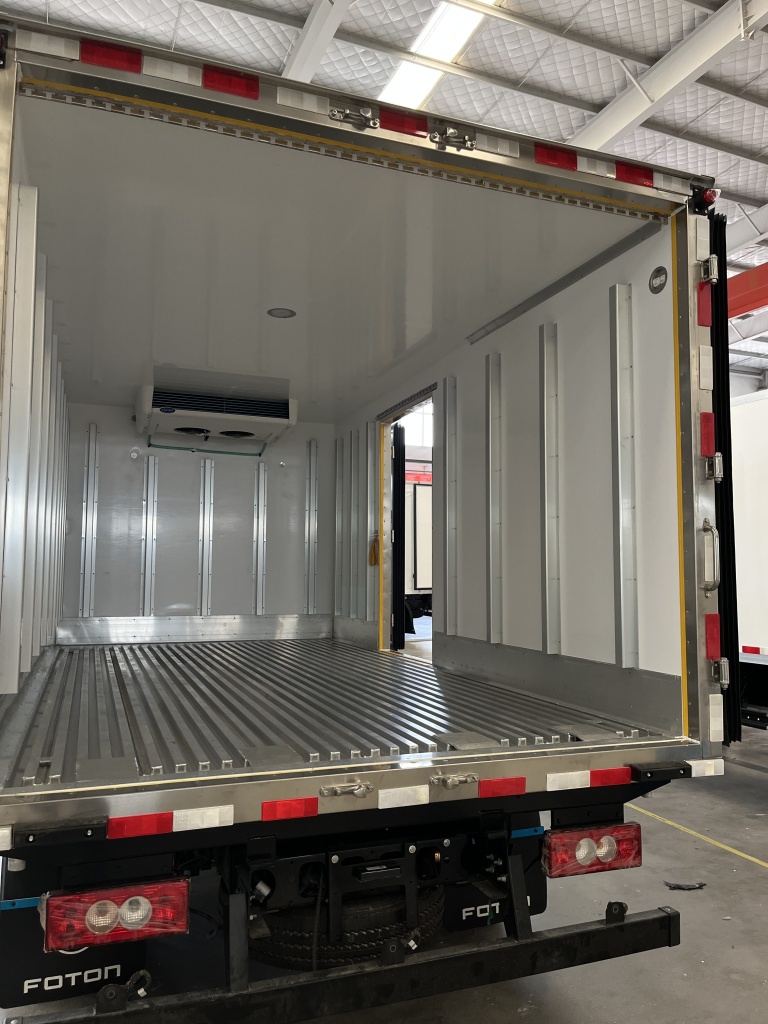
- Dual-zone bodies use insulated partitions and separate control so two temperature bands can travel together.
- Interior surfaces should be smooth and cleanable, with defined drainage, because hygiene and cross-contamination control are part of the same inspection.
- Body weight matters on the same chassis: a 4.2 m refrigerated body can be built at roughly 670 kg, and instrumentation and partitions add to that.
A vs B: Single-Zone vs Dual-Zone Pharmaceutical Body
- Cargo flexibility — Single-zone bodies carry one temperature band cleanly; dual-zone bodies let refrigerated and ambient or frozen product travel on one trip.
- Control complexity — Single-zone control is simpler and easier to validate; dual-zone control requires independent sensors, evaporators and documented zone mapping.
- Temperature mapping — Single-zone mapping is quicker; dual-zone mapping has to be done per zone, including the partition and door areas.
- Payload effect — Partitions, extra evaporators and monitoring hardware add weight, reducing usable payload on the same chassis.
- Route fit — Single-zone suits dedicated distribution to clinics or warehouses; dual-zone suits mixed deliveries where a second temperature band is needed on the same run.
Step-by-Step: How to Specify a Pharmaceutical Body
1) Confirm the temperature range and the product licence requirements. Write down the target band and the acceptable excursion limits before discussing body options.
2) Decide single or dual zone based on your actual route. Adding a zone that is rarely used adds weight and complexity you will maintain for years.
3) Specify monitoring and alarms explicitly. Ask for continuous logging, alarm thresholds, sensor placement and how the data is exported for the receiving party.
4) Agree on panel thickness and door design for the temperature band. Tighter bands justify more insulation and better sealing, and door openings should be minimised and controlled.
5) Plan cleanable interior surfaces and drainage. Smooth linings, sealed joints and a working floor channel make routine cleaning and inspection straightforward.
6) Define the operating procedure and check local rules. Pre-cooling, loading discipline, door protocol and out-of-range actions should be written down for the drivers, and GDP, GSP and national requirements vary, so confirm the specification against the regulations that apply to your market.
FAQ
Q: What temperature should a vaccine transport vehicle hold?
A: Many refrigerated vaccines are handled in a 2 to 8 degrees Celsius band, but the correct range comes from the product licence holder, not from a general rule. Always confirm the required range and any excursion tolerance with the manufacturer or your quality team.
Q: Is a data logger enough, or do I need continuous monitoring?
A: A logger that records the whole journey is the usual expectation, and many operations add live monitoring with alarms so an out-of-range event is noticed during the trip rather than after delivery. Discuss what your receiver requires before specifying.
Q: Do pharmaceutical loads need a different body construction?
A: The insulated structure follows the same mature methods used for food transport: FRP sandwich panels or polyurethane integral foam. What changes is the specification level — tighter sealing, more insulation for narrow bands, instrumentation and cleanable surfaces.
Q: How do I handle a temperature excursion?
A: Follow a documented procedure: isolate the affected load, retrieve the logged data, notify the consignee, and let the quality owner decide on usability. The vehicle's job is to make that decision possible by providing reliable records.
Q: Does dual-zone operation affect validation?
A: Yes. Each zone needs its own temperature mapping, and the partition and door areas deserve extra attention because that is where the two zones interact. Budget time for mapping before the vehicle enters service.
Conclusion
Specifying a pharmaceutical refrigerated truck is mostly about proof: the right temperature band, reliable control, continuous records, alarms and cleanable surfaces. Insulation choices come from the same mature constructions used across the refrigerated range, applied at a tighter specification. Before you order, confirm the required range with the product licence holder and your quality team, then build the vehicle and the operating procedure around that number.
Single Truck or Fleet? Logistics Planning for Growing Hatcheries
Sep 21, 2026
Preventing Condensation and Ice Build-up in Refrigerated Truck Bodies
Sep 23, 2026
Related Articles
Author

Cybercoldchain
Content Writer
Recent Posts
-
GMP+ and FAMI-QS: Is Transport the Weak Link in Feed Safety?
Oct 31
-
Driver Shortages vs Delivery Windows: What Gives First?
Oct 31
-
Telematics for Bulk Feed: Is Bin-Level Data Worth the Investment?
Oct 31
-
Can Reefers Keep Up With 45°C+ Markets—or Do Specifications Need a Rethink?
Oct 31
-
The Hidden Cost of a Late Chick Delivery—Who Should Bear It?
Oct 31