
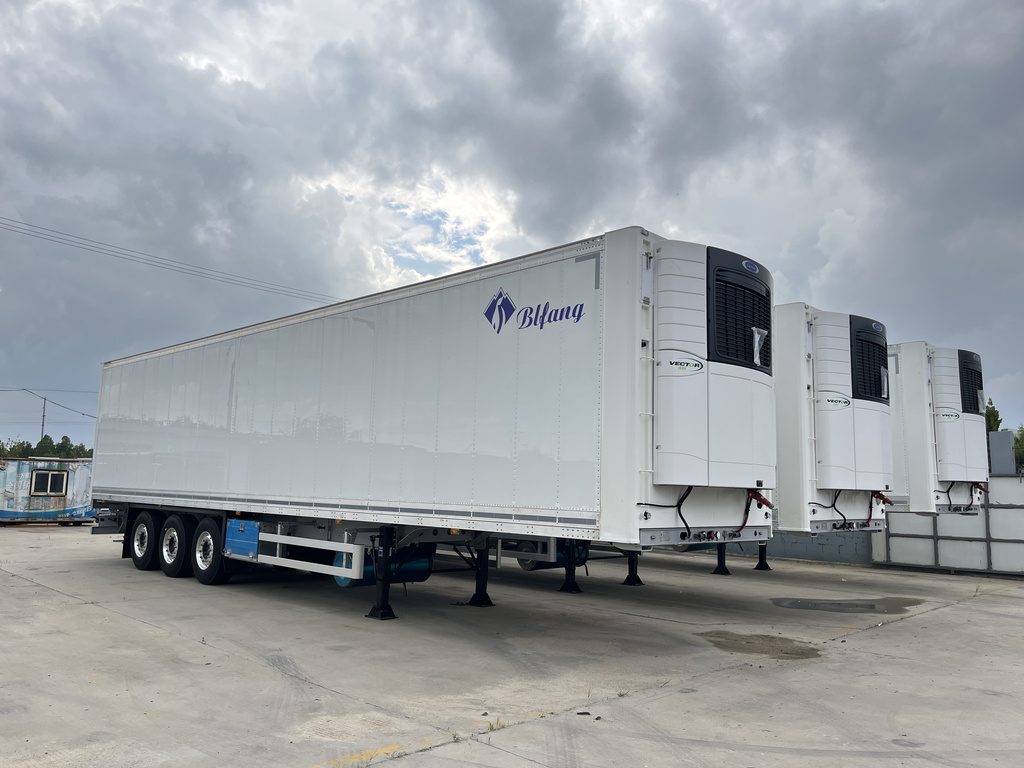
Can Reefers Keep Up With 45°C+ Markets—or Do Specifications Need a Rethink?
In short: A modern refrigerated unit can usually hold setpoint in a 45 °C market. What it struggles with is recovery — the period after a door event, a warm load, or a long idle in the sun. Hot-climate failures are rarely steady-state failures, so the specification should be written around recovery, not around a brochure setpoint.


What Is High-Ambient Reefer Specification?
High-ambient specification means designing the body and unit around the conditions the vehicle will actually work in, not a temperate default. Three choices interact: how much heat the body lets in, how much the unit can remove, and how quickly the system returns to setpoint after a disturbance.
Heat ingress is driven by the temperature difference across the panel: frozen cargo at -18 °C against 45 °C ambient is roughly 63 K, versus about 43 K against 25 °C. The same body and unit behave like different machines in those two markets, which is why a specification copied from a temperate catalogue can underperform in the Gulf or West Africa without anything being defective.
Why This Debate Matters
Export markets with sustained high ambient temperatures are a growing share of refrigerated transport demand, and buyers there increasingly inspect specifications rather than accept them. Fleets discover the gap in the worst week of summer, when units that held setpoint all spring start alarming at midday.
The commercial argument is about where to spend. Thicker insulation costs payload and purchase price but reduces load every hour. A larger unit costs fuel and maintenance and adds front-end weight, but recovers faster. Both can produce a vehicle that works in July; the question is which still works in year five, with a condenser that has never been washed.
Key Facts at a Glance
- Heat flow through a panel scales with the temperature difference: -18 °C cargo against 45 °C ambient gives about 63 K, versus about 43 K against 25 °C.
- Polyurethane integral foam is mature at closed-cell content of at least 95% and conductivity near 0.022 W/(m·K); FRP sandwich dry-bonding is an equally established construction with different weight and repair economics.
- Panel thickness buys thermal margin continuously, while unit capacity buys recovery speed — the two are not interchangeable, and each has a mass penalty.
- A 4.2 m refrigerated body can weigh around 670 kg; adding thickness or a larger unit reduces payload, which matters more on light commercial chassis than on heavy tractor units.
- Condenser performance falls as ambient air temperature rises, and a fouled or restricted condenser makes a hot-climate problem worse regardless of body quality.
- Solar load on roof and sun-facing side adds to conduction; body colour, parking orientation and shade cost almost nothing.
Two Sides: Thicker Insulation vs Bigger Unit
- What actually fails — Insulation camp: steady-state margin protects cargo during long idle and slow traffic; Unit camp: alarms appear after doors and loading — a capacity problem, not leakage.
- Capital cost — Insulation side: thicker panels raise body price and reduce payload; Unit side: a larger unit raises price, fuel burn and service cost, and may need a bigger alternator or engine envelope.
- Recovery speed — Insulation side: less heat enters, so there is less to remove; Unit side: recovery tracks capacity directly, and insulation cannot pull down a warm pallet.
- Fuel and emissions — Insulation side: a lower load means the unit works less in every hour; Unit side: a larger unit runs at part load most of the time, which is not automatically inefficient.
- Retrofit and repair — Insulation side: panel damage is repairable but thickness cannot be added later; Unit side: units can be replaced or upgraded, which makes them the flexible lever.
- Failure behaviour — Insulation side: degradation is gradual and shows as longer recovery over months; Unit side: a single condenser or fan fault can remove capacity abruptly.
Step-by-Step: How to Specify for a Hot Market
- Write the design ambient, not the average. State the condition the vehicle must hold at midday in the hottest month, including solar exposure, and require the supplier to demonstrate performance at that condition.
- Specify recovery, not just setpoint. Define a door-open scenario — duration, frequency, cargo temperature at loading — and ask how long the system takes to return to band. That number predicts real performance.
- Check condenser installation, not just condenser rating. Airflow, recirculation, proximity to the body and protection from dust decide whether the rated capacity is available in service.
- Treat pre-cooling as part of the specification. A body pulled down before loading and cargo loaded at temperature is worth more in a hot market than an extra kilowatt of capacity.
- Choose body finish and parking practice deliberately. Light colours, shaded parking and avoiding long midday idling all reduce load at no capital cost.
- Field-test in the hot week. Borrow a data logger, run a normal route, compare recovery against the specification. If nobody tests in July, nobody knows.
FAQ
Q: Is 45 °C ambient outside the operating range of standard reefers?
A: Not usually. Most units are rated for high ambient operation, but capacity at that condition is lower than at temperate conditions and the margin for recovery shrinks. The constraint is margin, not capability.
Q: Should I always choose thicker panels in hot markets?
A: Not automatically. Thicker panels help most on long holding periods and slow routes. On high-drop urban work, recovery capacity and door discipline often matter more per unit of cost.
Q: Does body colour really make a measurable difference?
A: It affects solar load, so lighter finishes reduce heat gain on sun-exposed surfaces. The effect is smaller than panel thickness but costs nothing and compounds over years.
Q: How do I know if my unit is derated in service?
A: Compare recovery time on a known route with the commissioning baseline. Gradual lengthening points to condenser fouling, refrigerant loss or insulation degradation — often combined.
Q: Are FRP sandwich bodies suitable for hot climates?
A: Yes. FRP sandwich and polyurethane integral foam are both mature options; what matters is the specified thickness, the joint quality and the achieved thermal performance, not the family name.
The Bottom Line
Hot-climate reefer performance is decided by recovery margin, not by a setpoint on a datasheet. Insulation and capacity are both legitimate levers, and the right mix depends on route length, door frequency and how much payload the chassis can spare. What is not legitimate is specifying from a temperate catalogue and hoping the summer is mild.
If your fleet had to prove recovery time at 45 °C, could anyone produce the number today?
The Hidden Cost of a Late Chick Delivery—Who Should Bear It?
Oct 31, 2026
Telematics for Bulk Feed: Is Bin-Level Data Worth the Investment?
Oct 31, 2026
Related Articles
Author

Cybercoldchain
Content Writer
Recent Posts
-
GMP+ and FAMI-QS: Is Transport the Weak Link in Feed Safety?
Oct 31
-
Driver Shortages vs Delivery Windows: What Gives First?
Oct 31
-
Telematics for Bulk Feed: Is Bin-Level Data Worth the Investment?
Oct 31
-
Can Reefers Keep Up With 45°C+ Markets—or Do Specifications Need a Rethink?
Oct 31
-
The Hidden Cost of a Late Chick Delivery—Who Should Bear It?
Oct 31