
Refrigerated Truck Door Configurations: Rear, Side and Multi-Temperature Access
Refrigerated Truck Door Configurations: Rear, Side and Multi-Temperature Access
In short: Every door you add makes loading faster and lets more heat in. Rear doors suit dock-based distribution, side doors suit street-level multi-stop work, and multi-temperature partitions let one body carry different product bands. The right choice is the layout that matches how your route actually loads and unloads.


What Is a Refrigerated Truck Door Configuration?
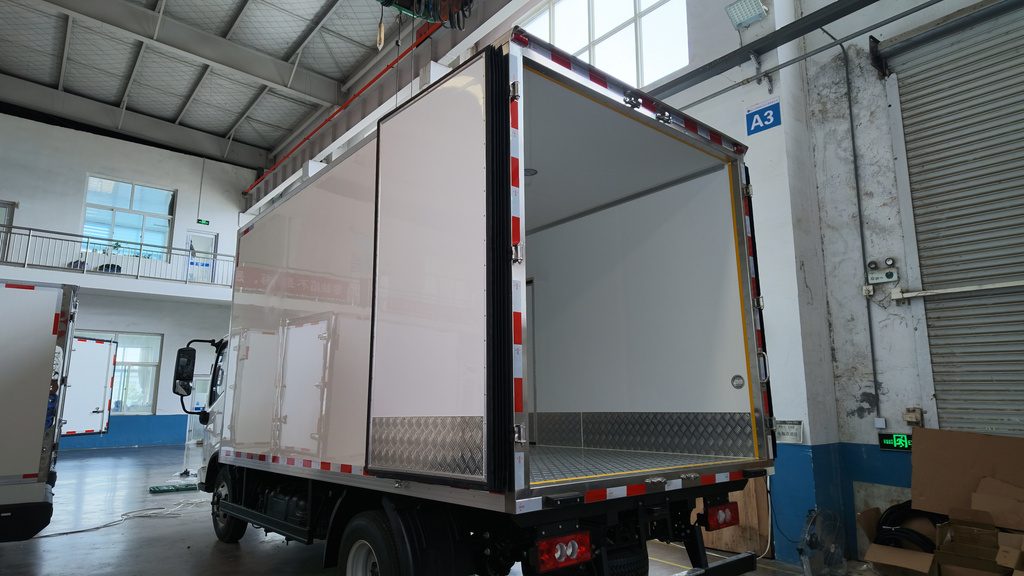
A refrigerated truck door configuration is the arrangement of openings on an insulated body: a rear doorway, one or more side doors, or internal partitions that divide the box into separate temperature zones. The configuration decides how quickly a driver can reach the load and how much cold air escapes each time the box is opened.
Doors are the weakest thermal point on any insulated body, because a doorway has to open, and every opening replaces cold air with warm ambient air. That is why door layout is a design decision rather than a convenience feature, and why it should be settled before panel thickness and cooling unit capacity are finalised.
Key Facts at a Glance
- Chilled product is normally carried at 0 to 4 degrees Celsius and frozen product at around minus 18 degrees Celsius, so compartments serving different bands need separate control.
- Door openings are a major source of heat gain. The more often the box is opened per shift, the more cooling load the unit must remove.
- Rear doors dominate dock loading, where a vehicle reverses to a leveller. Side doors reduce the open time per stop on street-level and kerbside delivery.
- Door gaskets, latches and hinge hardware are wear items. Regular inspection of the seal keeps a correctly built body performing as designed.
- Multi-temperature bodies separate cargo with insulated partitions and often use a second evaporator or an air distribution system to hold each zone.
- Insulated bodies for these layouts are built with the same two mature methods: FRP sandwich panels and polyurethane integral foam.
A vs B: Rear-Only vs Side-Door Access
- Loading pattern — Rear-only suits dock loading where the whole load is handled at one place; side doors suit routes with several drops and partial unloads.
- Cold loss per stop — Rear-only loses a large volume of cold air each time the full doorway opens; a side door opens a smaller aperture for a shorter time.
- Route fit — Rear-only works well for trunk runs, plant-to-warehouse movement and full-load delivery; side access suits urban multi-stop delivery and mixed loads.
- Body structure — Rear-only keeps the side panels continuous, which is simpler; side doors need framing and reinforcement in the side wall.
- Maintenance — Both need gasket care. Side doors add another sealing surface, another latch set and another set of hinges to check.
Step-by-Step: How to Choose a Door Configuration
1) Map your route and count drops. If the vehicle makes many stops with partial unloads, side access usually pays for itself in reduced open-door time.
2) Decide how the vehicle loads at the origin. Dock levellers, forklift access and pallet dimensions all constrain the rear doorway size and height.
3) Check the temperature bands you need. If chilled and frozen product travel together, plan compartments and confirm how each zone will be controlled.
4) Match doorway size to your unit load. Pallet dimensions and trolley sizes determine the clearance you need, and a doorway that is too small forces manual re-handling.
5) Confirm sealing and drainage details. Ask about gasket type, latch adjustment, floor channels and how the door threshold is insulated.
6) Agree on a maintenance routine. A short monthly check of gaskets, hinges and latches keeps heat gain low for the life of the body.
FAQ
Q: Are side doors worth the extra cost?
A: On multi-stop work they often are, because they reduce the time the large rear doorway stays open. On dock-based distribution with one loading point, their benefit is smaller. The decision follows route pattern and drop count more than vehicle size.
Q: Can I add a side door to a body that already has rear doors?
A: It is common to specify both. The side wall then needs framing and reinforcement around the opening, so it is worth deciding at the design stage rather than added later. Include it in the original quotation.
Q: How do multi-temperature compartments work?
A: Insulated partitions divide the box into zones, and each zone is controlled by its own evaporator or air distribution arrangement. Bulkheads and door discipline matter, because a zone only holds temperature if the separation is respected during loading.
Q: What happens if a door gasket fails?
A: Warm, moist air enters continuously, so the unit runs longer and you may see condensation or frost near the door. Gaskets are inexpensive relative to a cooling unit, which is why a quick monthly inspection is worth the time.
Q: Does door configuration affect cooling unit sizing?
A: Yes indirectly. Door openings change the heat load the unit must remove, so a route with frequent access should be described honestly when the unit is selected. Sizing on a single-drop duty cycle and then running multi-stop routes is a common mismatch.
Conclusion
Door configuration decides how fast you can work and how much cold air you lose doing it. Rear doors for dock loading, side doors for street-level stops, partitions when two temperature bands travel together: each option is a trade of speed against heat gain. Settle the layout first, then confirm panel thickness, gasket quality and cooling capacity against it. If you specify a body with your route in mind, the doors stop being a compromise and start being an asset.
Chick Transport Emergency Plan: If the AC or Ventilation Fan Fails
Sep 29, 2026
Axle Loads and Weight Distribution in Bulk Feed Trucks
Sep 29, 2026
Related Articles
Author

Cybercoldchain
Content Writer
Recent Posts
-
GMP+ and FAMI-QS: Is Transport the Weak Link in Feed Safety?
Oct 31
-
Driver Shortages vs Delivery Windows: What Gives First?
Oct 31
-
Telematics for Bulk Feed: Is Bin-Level Data Worth the Investment?
Oct 31
-
Can Reefers Keep Up With 45°C+ Markets—or Do Specifications Need a Rethink?
Oct 31
-
The Hidden Cost of a Late Chick Delivery—Who Should Bear It?
Oct 31