
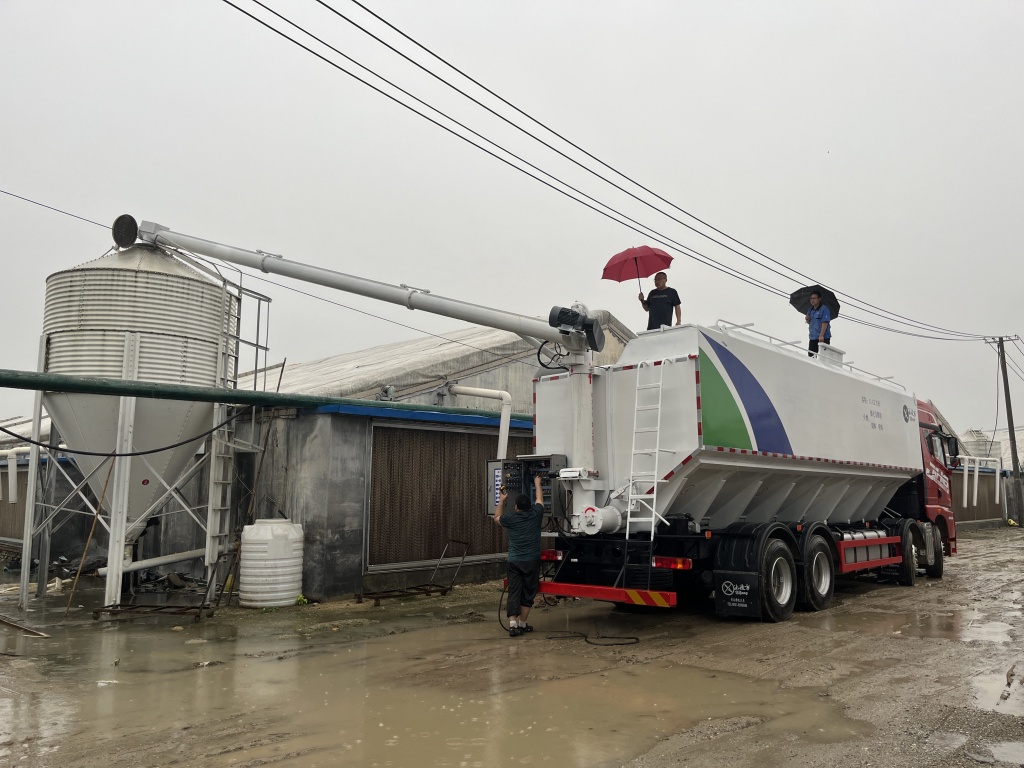
Telematics for Bulk Feed: Is Bin-Level Data Worth the Investment?
In short: It depends on what decision the data changes. Telematics pays where it removes a real, recurring cost — an empty bin, a wasted trip, an unexplained loss — and disappoints where it produces dashboards nobody acts on. Bin-level sensing is the most hyped layer and the one most likely to be oversold, because knowing a bin is low is not the same as being able to deliver to it.


What Is Bulk Feed Telematics?
Bulk feed telematics is the instrumentation of a feed delivery operation: vehicle tracking, driver behaviour and hours data, onboard weighing, discharge monitoring, and increasingly remote sensing of farm bin levels. It connects the truck, the load and the receiving point into a stream of records that can be reviewed after the fact or acted on in real time. The category is broad, and vendors often bundle distinct capabilities — location, weight, level, temperature — as if they were a single product with a single return.
Why This Debate Matters
Bulk feed fleets run on tight schedules and thin margins, and the two most expensive failures are an unnecessary trip and an empty bin at a critical feeding moment. Both look like obvious targets for instrumentation, and both are harder to solve than a sensor suggests. Connectivity in rural areas is imperfect, bin installations are physically awkward, and the data has to land in a workflow someone owns. Meanwhile, equipment budgets are finite: money spent on sensing is money not spent on a better body, a second compartment or driver retention. The debate is not whether telematics works, but where in the stack it earns its place first.
Key Facts at a Glance
- GPS tracking is the most mature layer and answers "where is the truck", not "what is in the bin".
- Onboard weighing measures the vehicle, and therefore supports load verification and residual checks, but requires calibration and is affected by slope and motion.
- Bin-level sensing ranges from simple point-level switches to continuous measurement, with very different installation effort and reliability.
- Farm connectivity is often the binding constraint; a sensor that cannot report is indistinguishable from a sensor that is not there.
- Telematics produces data, not decisions; the value depends on who reviews it and what they are authorised to change.
- Retrofitting sensors to existing bins and older trailers usually costs more per unit than factory-fitted options, and that difference shapes the payback case.
Two Sides: A vs B
- Starting point — One camp starts with vehicle tracking and onboard weighing because the data is reliable and the hardware is proven; the other starts with bin sensing because that is where the expensive failure occurs.
- Reliability — Sensor advocates point to falling hardware costs and improving networks; sceptics point to dusty, humid, vibration-heavy farm environments where instruments fail quietly.
- Decision ownership — Some fleets reorganise planning around live data, giving dispatchers authority to reroute; others keep weekly planning and use telematics only for reporting, which limits its value.
- Payback logic — Vendors frame payback around avoided empty bins and reduced trips; operators counter that avoided events are hard to prove, so the case is often made on faith.
- Driver relationship — Telematics can be presented as support, giving drivers better information; it can also be experienced as surveillance, with predictable effects on cooperation.
- Build versus buy — Integrated systems from a single vendor simplify support; specialized components often fit existing workflows better but create integration work.
Step-by-Step: How to Evaluate a Telematics Investment
- Name the decision. Write down the specific decision the data will change — dispatch, rerouting, maintenance, loss investigation — and who makes it.
- Cost the failure. Estimate what one empty bin or one wasted trip costs, using your own records rather than a vendor's example.
- Pilot one route. Instrument a single route or customer for a defined period and compare outcomes with a control route.
- Test the workflow, not the hardware. Verify that data reaches the person who acts, in time to act, in a form they can use.
- Check the total cost. Include installation, calibration, connectivity, subscription, replacement and the staff time to maintain it.
- Set a review date. Decide in advance what result would justify expansion, and what would justify stopping.
FAQ
Q: Is bin-level monitoring necessary for a small fleet?
A: Often not. Below a certain scale, a disciplined delivery calendar and a phone call to the farm may resolve the same problem at far lower cost, though the threshold depends on distances and bin sizes.
Q: Can onboard weighing detect feed loss?
A: It can support loss investigation by showing load weight at departure and after discharge, but it measures the vehicle rather than the delivered product, so moisture and spillage still need separate attention.
Q: What usually causes telematics projects to fail?
A: Not hardware. Failure is usually a workflow problem: nobody owns the alerts, the data arrives too late to act on, or the system measures something the operation cannot change.
Q: Does telematics help with driver shortages?
A: It can help schedulers use available drivers more efficiently and reduce unproductive waiting, but it does not create drivers, and it can worsen retention if it is perceived as purely disciplinary.
Q: Should sensors be factory-fitted or retrofitted?
A: Factory-fit integration is usually cleaner and more durable; retrofit is cheaper to start and more flexible across a mixed fleet. The right answer follows fleet age and how long you intend to keep the assets.
The Bottom Line
Telematics is neither a silver bullet nor a gimmick; it is an amplifier of management attention. Where a fleet already knows its costs and has people empowered to act, data compounds the advantage. Where planning is informal, instrumentation mostly documents the chaos. The honest test is not whether the system works in a demonstration, but whether anyone changes a decision because of it. Which single decision in your operation would you most want better data for — and would you actually act on it differently?
Can Reefers Keep Up With 45°C+ Markets—or Do Specifications Need a Rethink?
Oct 31, 2026
Driver Shortages vs Delivery Windows: What Gives First?
Oct 31, 2026
Related Articles
Author

Cybercoldchain
Content Writer
Recent Posts
-
GMP+ and FAMI-QS: Is Transport the Weak Link in Feed Safety?
Oct 31
-
Driver Shortages vs Delivery Windows: What Gives First?
Oct 31
-
Telematics for Bulk Feed: Is Bin-Level Data Worth the Investment?
Oct 31
-
Can Reefers Keep Up With 45°C+ Markets—or Do Specifications Need a Rethink?
Oct 31
-
The Hidden Cost of a Late Chick Delivery—Who Should Bear It?
Oct 31