
The Hidden Cost of a Late Chick Delivery—Who Should Bear It?
In short: The visible cost of a late delivery is a phone call and a discount. The real cost lands on the chick, then on the farm's first week, and is usually absorbed by whoever has least bargaining power rather than by whoever caused the delay. Contracts that name a delivery window and nothing about consequence practically ensure the argument repeats.


What Is a Late Chick Delivery?
A late delivery is not simply an arrival after an agreed hour. In day-old chick logistics it is any arrival that pushes the birds past the condition they were expected to be in — which depends on time, temperature, airflow and how long they have already been boxed. Two loads can arrive at the same hour and only one is late in any meaningful sense.
The distinction matters: a clock-based definition is easy to administer and easy to dispute; a condition-based one is harder to write and closer to what the customer bought.
Why This Debate Matters
A day-old chick has one job in its first hours: stabilise. It needs warmth, air and, soon after, water and feed. Every hour in a box on a warm tarmac is an hour not spent doing that, and the effect compounds — dehydrated chicks start slower, and a slow start is hard to recover in a short cycle.
The farm experiences it as a scheduling shock: brooding space is heated and waiting, staff are booked, and the placement plan is built around an arrival time. When the truck is late, either the house sits warm and empty, or it has been waiting too long and must be adjusted quickly.
Then comes the argument: the carrier blames the hatchery's pull, the hatchery blames a route planned too tightly, the farm points at the chicks. Everyone is partly right, which is why the cost lands on whoever cannot afford to argue — usually the farm, and ultimately the bird.
Key Facts at a Glance
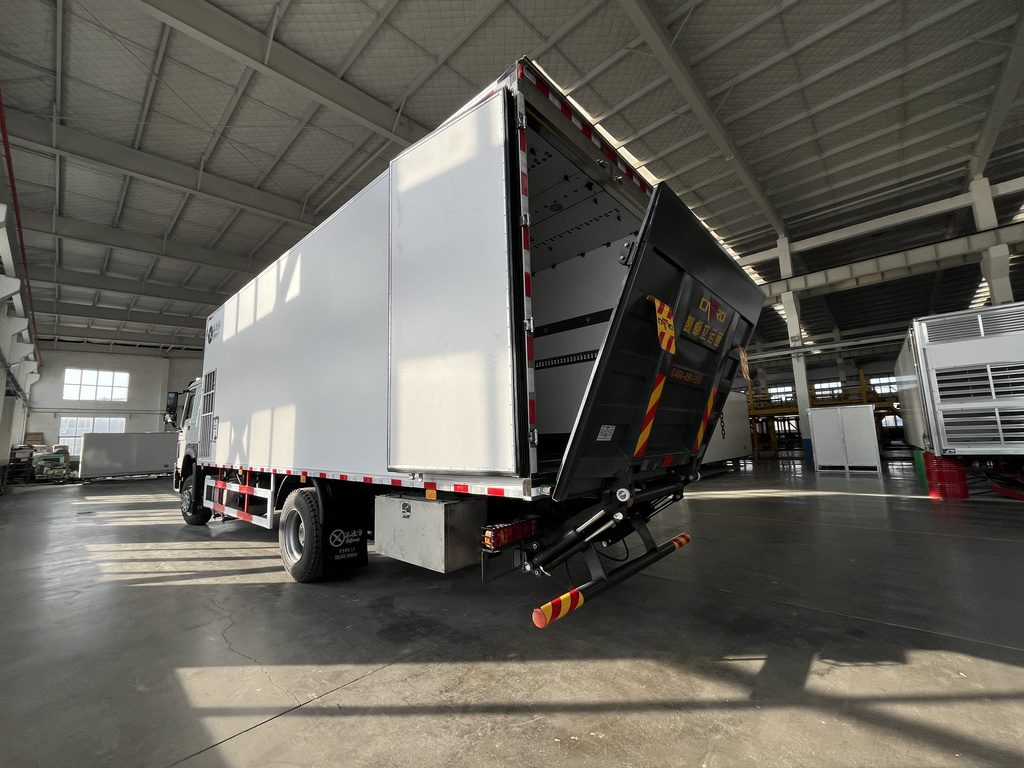
- The cargo space of a constant-temperature chick truck is held at 22–26 °C; that band is narrow because day-old chicks cannot yet regulate their own temperature.
- CO₂ inside a loaded box rises with time and bird mass; the ceiling is 3000 ppm, with 2800 ppm as an operating target. A stationary truck reaches it faster than a moving one.
- The standard chick box is 640 × 480 × 170 mm, so a delay affects a known, countable number of birds rather than an abstract tonnage.
- Load size is route-defining: 232 boxes at 4.2 m, 464 at 6.8 m, 536 at 7.8 m, 672 at 9.6 m for ventilated units, and 624 boxes (24 carts × 26) at 9.6 m for a constant-temperature unit.
- A constant-temperature unit's backup is a chassis generator driving the fans only, plus a battery giving roughly two hours for fans — not a second cooling system.
- Ventilated units rely on fans and ventilation windows, with an optional auxiliary cooling unit of limited effect; in hot weather a stationary ventilated truck has little margin.
Two Sides: A vs B
- What was promised — Carrier view: a delivery window is an estimate, and traffic is not a controllable input. Buyer view: a window that is not met is a broken commitment, whatever the cause.
- Where the delay started — Hatchery view: late pulls are normal biological variance and the truck should wait. Carrier view: waiting is unpaid time, and the next three farms pay for it.
- How to value the loss — Contract view: compensate the freight or the invoice, because that is measurable. Farm view: the loss is a week of performance, which no freight credit covers.
- Who holds the information — Carrier view: nobody called to say the load would be late, so no mitigation was possible. Hatchery view: the route was known to be tight and was accepted anyway.
- What prevention looks like — Buffer view: add slack to every schedule. Efficiency view: slack is a cost paid on every load to cover an occasional failure.
Step-by-Step: How to Allocate the Cost Fairly
- Define lateness by condition, not only by clock. Write the arrival standard as time, cargo temperature and CO₂ together, so disputes have data instead of adjectives.
- Record the handover. Note time, temperature and CO₂ when doors close and when they open. Most arguments collapse when both parties see the same readings.
- Separate causes in the contract. Hatchery pull variance, carrier departure, border delay and weather should each have a named consequence. One clause for all four is a clause that will be litigated.
- Price waiting explicitly. If waiting is free, it will be overused. A stated hourly rate makes the trade-off visible to the person deciding whether to hold the truck.
- Agree a mitigation ladder. At thirty minutes late, who calls whom? At two hours, is the route shortened? Decide before the season, when nobody is angry.
- Review the three worst loads each quarter. Root-cause them together with the log open: the point is removing the recurring cause, not blame.
FAQ
Q: Is the carrier always responsible for a late arrival?
A: No. If departure was delayed by a late pull, the carrier inherited the delay. Responsibility follows cause, which is why the handover record matters more than the arrival time.
Q: Can a freight discount compensate a farm for a late load?
A: Rarely in full. Freight is a small fraction of the value at stake in the first week, so a discount settles the invoice, not the loss.
Q: What if the delay was caused by a border?
A: Border delay is a known risk class, not an excuse. Allocate it in advance — usually to whoever chose the route — and mitigate by scheduling crossings at lower-risk hours.
Q: Does a bigger truck make lateness worse?
A: It concentrates more chicks into a single delay. A late 9.6 m ventilated load of 672 boxes is a larger event than a 4.2 m load of 232.
The Bottom Line
A late chick delivery is a small operational failure with a disproportionate biological cost, and the industry's habit of settling it with a freight discount hides that cost instead of allocating it. The fair rule is simple to state and hard to practise: whoever caused the delay carries the consequence, and the record must be good enough to identify them. Until contracts measure condition as well as clock time, the farm keeps absorbing what the paperwork cannot see. So here is a question worth answering honestly: on your last late load, who actually paid?
Measuring Feed Loss in Transit: Do Fleets Even Know Their Real Loss Rate?
Oct 31, 2026
Can Reefers Keep Up With 45°C+ Markets—or Do Specifications Need a Rethink?
Oct 31, 2026
Related Articles


Author

Cybercoldchain
Content Writer
Recent Posts
-
GMP+ and FAMI-QS: Is Transport the Weak Link in Feed Safety?
Oct 31
-
Driver Shortages vs Delivery Windows: What Gives First?
Oct 31
-
Telematics for Bulk Feed: Is Bin-Level Data Worth the Investment?
Oct 31
-
Can Reefers Keep Up With 45°C+ Markets—or Do Specifications Need a Rethink?
Oct 31
-
The Hidden Cost of a Late Chick Delivery—Who Should Bear It?
Oct 31