
Africa's Poultry Boom: Can Transport Infrastructure Keep Up?
In short: Hatchery capacity is expanding faster than the transport layer that connects it to farms. The binding constraint is not the number of chicks that can be hatched, but the number that can arrive in good condition over long, hot, poorly surfaced routes. Until vehicle specification and route planning catch up, growth will be uneven and concentrated near cities.


What Is Poultry Transport Infrastructure?
Poultry transport infrastructure is the combination of vehicles, roads, cold-chain support, fuel availability, repair capacity and border arrangements that lets live birds or hatching eggs move from production to use. A route is only as good as its worst segment: a paved highway ending in forty kilometres of unsealed road sets the vehicle specification for the whole journey.
For day-old chicks the requirement is stricter than for most agricultural cargo. The birds cannot eat or drink, cannot regulate temperature well, and have no tolerance for a long unplanned stop. Infrastructure adequate for feed or equipment is not automatically adequate for a box of chicks.
Why This Debate Matters
Poultry consumption is rising across much of Africa, driven by urban growth and demand for affordable protein. Investment has followed: hatcheries, feed mills and processing capacity are expanding in several countries. That is the visible part.
The less visible part is distribution. A hatchery serves a radius defined by how far a chick can travel and still arrive in condition, not by how far a truck can drive. When that radius is short, hatcheries cluster near demand and rural producers stay underserved. When it is long but the vehicles are not built for it, mortality and poor quality absorb the gain.
There is also a maintenance dimension easily overlooked. A vehicle specified in Europe or East Asia assumes a service network, genuine filters and diagnostic support within reach. Where those assumptions fail, reliability decides the outcome more than purchase price. So "can infrastructure keep up" is partly a question about what kind of vehicle is realistic, not only about kilometres of road.
Key Facts at a Glance
- Chick transport equipment is specified for −35 °C to +40 °C ambient, and much of Africa's chick-producing belt sits at the upper end of that range for part of the year.
- Constant-temperature units hold the cargo space at 22–26 °C while outside temperatures climb, which means cooling capacity — not insulation alone — sets the achievable route length.
- CO₂ inside a loaded box must stay at or below 3000 ppm, with 2800 ppm as an operating target; long, hot journeys with poor airflow reach that limit faster.
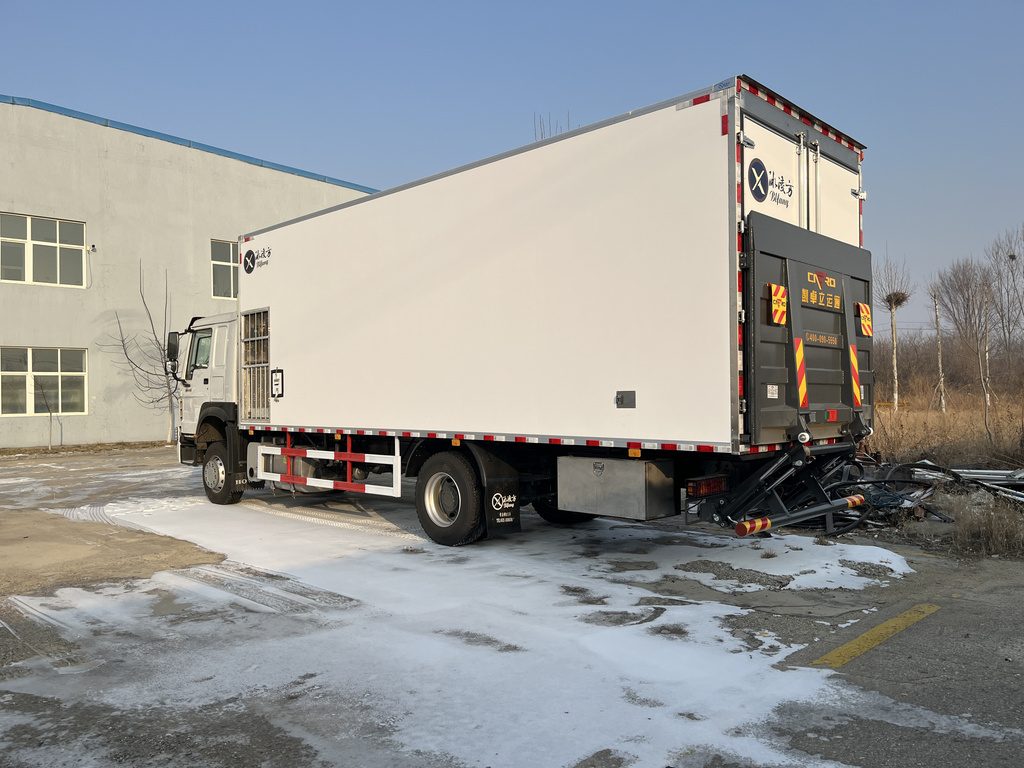
- Ventilated trucks rely on fans and ventilation windows, with an optional auxiliary cooling unit of limited effect; they suit shorter or milder routes rather than extreme heat over long distance.
- Load size varies with body length: 232 boxes at 4.2 m, 464 at 6.8 m, 536 at 7.8 m, 672 at 9.6 m for ventilated units, and 624 boxes as 24 carts of 26 on a 9.6 m constant-temperature unit.
- Cart-based loading shortens door-open time at each stop, which matters most where a route has many small drops.
Two Sides: A vs B
- What limits growth — Capacity view: more hatcheries and better genetics will meet demand. Logistics view: the last hundred kilometres decides whether that capacity reaches the farm.
- Which vehicle suits the market — Simple view: ventilated trucks are cheaper, easier to repair and adequate for most routes. Sophisticated view: where ambient exceeds the comfort band for hours, only active cooling protects the load.
- How to handle road quality — Vehicle view: specify suspension, tyres and ground clearance for the worst segment. Network view: invest in collection points so vehicles stay on sealed roads.
- Spare parts and service — Import view: buy the most affordable unit and source parts locally. Lifecycle view: a vehicle with no service network becomes a fixed cost with a short working life.- Who should own the fleet — Hatchery view: control the asset to protect chick quality. Distributor view: local operators know the routes and can spread risk across customers.
Step-by-Step: How to Plan for Weak Infrastructure
- Map the route by segment, not by distance. Record surface type, gradient, seasonal flooding and typical delay points. Two routes of equal length can require different vehicles.
- Specify for the worst hour, not the average day. Design cooling and ventilation around the hottest expected ambient and the longest expected stop, not the annual mean.
- Build in self-sufficiency. Carry spare belts, filters and basic tools. A two-hour roadside repair is minor; a two-hour wait for a mechanic is a load event.
- Use collection points where roads degrade. A shaded, ventilated transfer point at the edge of a poor network can extend effective radius without new vehicles.
- Train drivers on load checks. A scheduled mid-route inspection of fans, doors and box condition catches most developing problems before they become losses.
- Track cost per delivered chick, not cost per kilometre. Fuel, repairs, losses and rejected loads together show which configuration works.
FAQ
Q: Are ventilated trucks enough for hot climates?
A: For short routes in moderate heat, often yes: fans and ventilation windows move air through the load. Over long distances at high ambient, an auxiliary cooling unit has limited effect and active cooling is the realistic option.
Q: How does road quality change vehicle choice?
A: Poor surfaces increase vibration and mechanical wear, and they slow average speed, which lengthens exposure time. The cooling requirement rises even as the vehicle works harder.
Q: Is a larger truck always more efficient?
A: Only when the load is full and the route supports it. A partly loaded 9.6 m unit costs more per delivered chick than a full 6.8 m unit, and its larger volume takes longer to cool after each door opening.
Q: What is the single most useful upgrade?
A: Reliable airflow with monitoring. Temperature and CO₂ data tell the operator whether the vehicle is doing its job, which is the precondition for fixing anything else.
The Bottom Line
Africa's poultry growth is real, but it will be shaped by distribution long before it is limited by hatching capacity. The operators who win the next phase will be those who treat the route as a design input — specifying vehicles for heat, distance and service reality rather than showroom conditions. That is less exciting than a new hatchery, and it decides whether chicks arrive alive and uniform. Which raises a practical question: in your market, is the constraint the number of chicks you can hatch, or the number you can deliver by noon?
Can Cold Chain Growth Be Sustainable—or Is Lightweighting Just Greenwashing?
Oct 24, 2026
Driver Behavior: The Most Underrated Factor in Chick Quality?
Oct 27, 2026
Related Articles
Author

Cybercoldchain
Content Writer
Recent Posts
-
GMP+ and FAMI-QS: Is Transport the Weak Link in Feed Safety?
Oct 31
-
Driver Shortages vs Delivery Windows: What Gives First?
Oct 31
-
Telematics for Bulk Feed: Is Bin-Level Data Worth the Investment?
Oct 31
-
Can Reefers Keep Up With 45°C+ Markets—or Do Specifications Need a Rethink?
Oct 31
-
The Hidden Cost of a Late Chick Delivery—Who Should Bear It?
Oct 31