
Driver Behavior: The Most Underrated Factor in Chick Quality?
In short: Yes, it is underrated, because it acts on every load and rarely appears in any specification. Two identical trucks on the same route can produce different arrivals purely on braking, cornering and how long the doors stay open. Equipment sets the ceiling; driving decides how close to it you get.


What Is Driver Behavior in Chick Transport?
Driver behavior is the set of decisions a driver makes between the hatchery gate and the farm gate: speed over poor surfaces, braking smoothness, cornering speed, when to stop, how long to leave doors open, whether to check the load mid-route, and how the vehicle is parked.
It is not a personality trait. It is a trainable set of habits, and it interacts directly with the physical environment inside the box — where chicks are standing on a floor that transmits every jolt, in a space where air distribution depends on doors staying closed.
Why This Debate Matters
Transport specifications are improving. Temperature control, ventilation, filters, monitoring — all of it is better understood than it was a decade ago, and buyers increasingly ask for evidence rather than assurances. That progress is real, and it has a side effect: it makes the remaining human variables look smaller than they are.
Consider what a chick experiences during a journey. It stands on a floor, packed closely, unable to move away from a disturbance. A hard brake compresses the load forward; a fast corner shifts it sideways. Repeated small events are not catastrophic individually, but they accumulate, and the birds arrive with less reserve than they left with.
Then there is the door. A driver who leaves the rear open while chatting at a stop is undoing the work of the ventilation system in a few minutes, particularly in hot weather. Nobody records that decision, and it does not appear in any certificate.
Key Facts at a Glance
- Cargo temperature is held at 22–26 °C; a door left open in high ambient breaks that band faster than the cooling system can restore it.
- CO₂ is capped at 3000 ppm with 2800 ppm as an operating target; a stationary idling truck with doors closed climbs toward the ceiling, and doors open in traffic do not help either.
- Equipment is designed for −35 °C to +40 °C ambient, which means drivers in hot markets are operating at the edge of the envelope for part of the year.
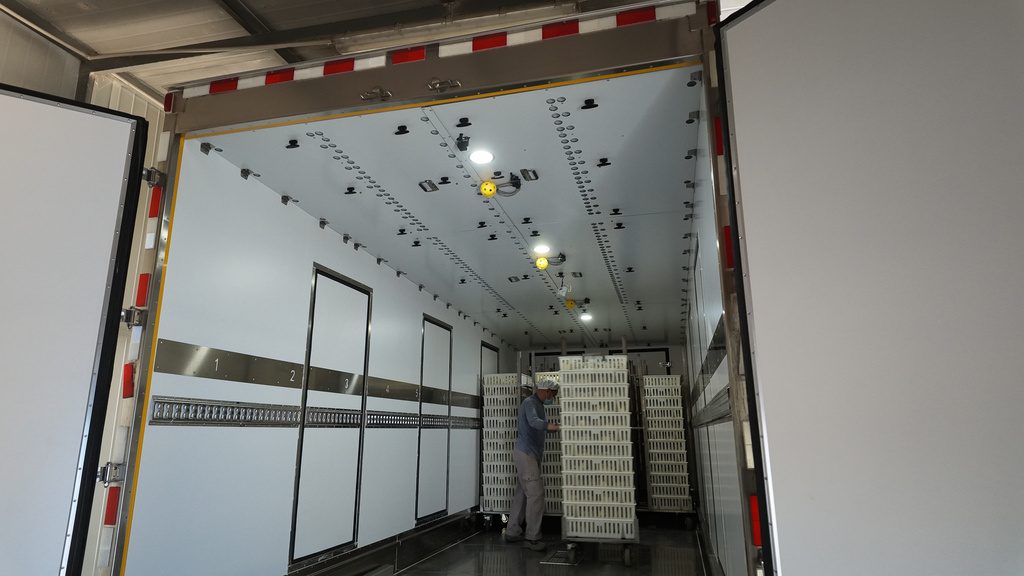
- The standard chick box is 640 × 480 × 170 mm; a sudden stop slides boxes against each other, and a poorly secured stack shifts as a block.
- Load size affects the driver's exposure: 232 boxes at 4.2 m, 464 at 6.8 m, 536 at 7.8 m, 672 at 9.6 m, or 624 boxes as 24 carts on a 9.6 m constant-temperature unit.
- Cart-based loading reduces the time doors are open at each stop, which limits how much of the thermal work is thrown away at every delivery.
Two Sides: A vs B
- What determines arrival quality — Equipment view: if temperature and ventilation are right, the load arrives right. Driving view: the equipment only works if the operator lets it, and the last hour is often the damaging one.
- How to improve it — Training view: brief drivers on smoothness, door discipline and load checks. Measurement view: record acceleration and braking events, then coach on data rather than on impressions.
- Who is responsible — Operator view: the driver is the professional on the scene and should use judgement. Management view: judgement is shaped by schedules, and a route planned too tightly forces the driving behaviour you later criticise.
- Speed versus time — Faster view: shorter exposure means less time in the box. Smoother view: a fast, rough route trades vibration for minutes, and the trade is usually bad.
- Stops and checks — Minimal view: every stop opens doors and costs thermal stability. Inspection view: a two-minute check of fans and load catches failures before they become losses.
Step-by-Step: How to Build Driving Discipline
- Define the standard in behaviours, not adjectives. "Smooth" is not a brief. "Brake earlier, corner below a stated speed, doors closed except during loading" is.
- Plan the route so the standard is possible. If the schedule requires speeding on poor roads, the schedule is the problem. Fix it before coaching the driver.
- Instrument the basics. A camera or an accelerometer log gives objective feedback and removes the argument about whether a particular corner was fast.
- Script the stops. Decide in advance what a mid-route check covers, how long it takes, and who opens which door. Unscripted stops drift into long ones.
- Coach individuals, not the group. Most variation sits with a few drivers. Group training is cheaper and changes less.
- Ask drivers what breaks the standard. They usually know which junction, which customer yard and which loading bay destroys the schedule. That knowledge is free and rarely collected.
FAQ
Q: Can driving really matter if the truck holds temperature?
A: Yes. Temperature control addresses heat, not mechanical disturbance. Chicks packed on a floor still experience braking and cornering directly.
Q: What is the single most useful rule?
A: Doors closed unless loading or unloading. It is simple, checkable, and protects the work the ventilation system is doing.
Q: Do experienced drivers need monitoring?
A: Everyone drifts under schedule pressure. Monitoring is less about trust and more about knowing when the schedule has started to override the standard.
Q: How do you measure driver effect on chick quality?
A: Compare arrival condition across drivers on similar routes and loads. Hold the route and the vehicle constant, and the remaining variation is largely human.
The Bottom Line
Specifications decide what a truck is capable of; driving decides what it delivers. That makes driver behavior the cheapest quality intervention available and the one most often left to chance, because it does not appear on a specification sheet or an invoice. The operators with the most consistent arrivals are usually the ones who treat the route plan and the driver brief as part of the equipment. So here is a question worth asking in the yard: if two of your drivers swapped trucks tomorrow, would the loads arrive the same?
Africa's Poultry Boom: Can Transport Infrastructure Keep Up?
Oct 26, 2026
Automation and Traceability: Will Bulk Feed Delivery Ever Be Fully Digital?
Oct 27, 2026
Related Articles
Author

Cybercoldchain
Content Writer
Recent Posts
-
GMP+ and FAMI-QS: Is Transport the Weak Link in Feed Safety?
Oct 31
-
Driver Shortages vs Delivery Windows: What Gives First?
Oct 31
-
Telematics for Bulk Feed: Is Bin-Level Data Worth the Investment?
Oct 31
-
Can Reefers Keep Up With 45°C+ Markets—or Do Specifications Need a Rethink?
Oct 31
-
The Hidden Cost of a Late Chick Delivery—Who Should Bear It?
Oct 31