
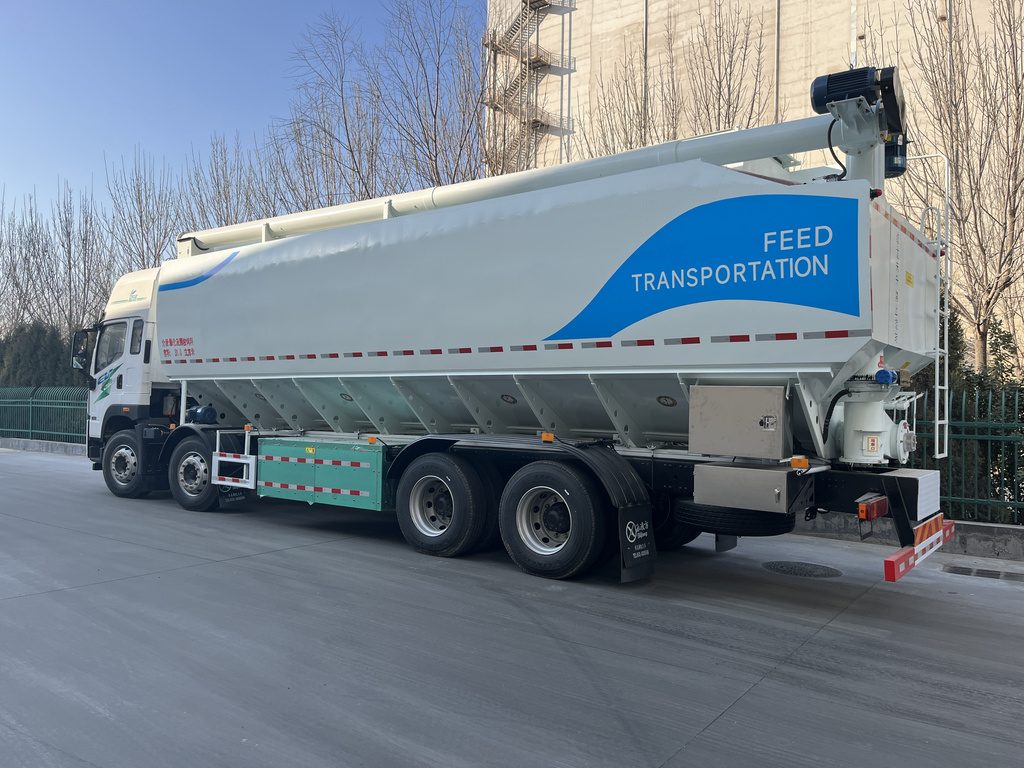
Automation and Traceability: Will Bulk Feed Delivery Ever Be Fully Digital?
In short: Nearly, but not completely, and the remaining gap is physical rather than digital. Weighing, load records, invoicing and route data can be automated today; connecting a hose to a farm bin, confirming the right silo, and judging whether the feed looks right still require someone on site. The realistic future is a highly instrumented process with a human at the last metre, not a driverless tanker filling bins unattended.


What Is Digital Feed Delivery?
Digital feed delivery is the replacement of paper and memory with captured data across the delivery chain: order, load weight, compartment assignment, vehicle location, discharge confirmation, delivery note and invoice, all linked to the same transaction record. Traceability extends that chain backwards to the mill batch and forwards to the farm bin, so a question about a specific delivery can be answered from records rather than reconstructed from recollections. Automation goes further, using that data to trigger actions without a person deciding each one.
Why This Debate Matters
Feed supply chains are being asked to prove more than they used to: what was delivered, when, in what condition, and from which batch. Buyers want this digitally because paper records are slow and easy to lose, and because reconciliation against invoices is now routine. Fleets want it because manual entry consumes driver time and produces errors that surface as disputes. Yet the investment case is uneven — a large mill with integrated customers can justify substantial systems, while a regional haulier serving small farms may find the cost per delivery difficult to defend. The debate is less about whether digital is better than about where the physical world refuses to cooperate.
Key Facts at a Glance
- Weighbridge and onboard weighing are the anchor of digital delivery, because weight is the number everyone eventually argues about.
- A delivery record is only traceable if it links order, load, compartment, vehicle, time and receiving bin in one chain.
- Farm connectivity is frequently the weakest link, particularly in rural areas and at sites with metal structures that interfere with signals.
- Bin identification is a common failure point: the right farm with the wrong silo is a real and recurring error.
- Digital signatures and proof-of-delivery remove paper but shift the dispute to whether the signature was informed.
- Integration between transport systems and mill ERP determines whether data is used or merely stored.
Two Sides: A vs B
- How far to automate — One view targets end-to-end automation with unattended discharge at equipped farms; the other argues that the marginal gains beyond weight and record capture are small compared with the cost and risk.
- Driver role — Some see the driver becoming a supervisor of automated equipment; others see the driver as irreplaceable precisely because the last metre is unpredictable.
- Traceability depth — Batch-level traceability satisfies most regulatory and customer needs; item-level or compartment-level granularity is more defensible but multiplies data collection effort.
- Standards versus custom integration — Open standards promise easier connection between systems; bespoke integration delivers a better fit today and a harder upgrade later.
- Proof of delivery — Photographic and geotagged evidence is strong but can feel adversarial; a simple signature is friendlier but weaker when disputed.
- Who owns the data — Mills, hauliers and farms all want access to delivery data, and the commercial tension over who holds the master record is often harder to resolve than the technology.
Step-by-Step: How to Digitalise Feed Delivery Sensibly
- Fix the data model first. Define what a delivery record must contain and which system is the master, before choosing hardware.
- Automate weight. Start with calibrated weighing and automatic capture, since this removes the most common dispute at the lowest cost.
- Identify the receiving point. Use a physical identifier at the bin — a tag, a code, a location check — so the truck cannot confirm the wrong silo.
- Capture at the point of action. Record discharge confirmation when it happens, not at the end of the shift.
- Integrate the invoice. Link delivery records to invoicing so reconciliation is automatic and errors surface immediately.
- Pilot on your most complex route. If the system survives a multi-stop, multi-compartment day, it will survive the easy ones.
FAQ
Q: Can feed delivery be fully automated?
A: Large parts can — ordering, loading records, weighing, documentation and invoicing. Discharge at an unmodified farm still needs a person, and most operations will retain a human check at the bin for the foreseeable future.
Q: Is traceability a regulatory requirement or a customer expectation?
A: Both, depending on the market. Feed safety frameworks increasingly expect records that allow a batch to be followed, and large customers often ask for more detail than the minimum.
Q: What is the cheapest first step?
A: Reliable weight capture tied to a unique delivery record. It addresses the most common dispute and creates the foundation for everything else.
Q: Do drivers slow digital adoption?
A: They can, when systems add work without adding value. Adoption improves when the digital record replaces paperwork rather than duplicating it.
Q: Will autonomous trucks solve the last mile?
A: They may address the driving, but the delivery task — access, hose connection, bin identification, spill judgement — remains the hard part. Autonomy on the road does not automatically solve automation at the farm.
The Bottom Line
Bulk feed delivery will become far more digital than it is today, and the gains will be real: fewer disputes, faster reconciliation, better traceability. It is unlikely to become fully automated, because the final step happens in muddy yards and unfamiliar sites where judgement still outperforms sensors. The practical goal is a complete digital record with a human at the point of physical contact. Which part of your delivery process would you most want to remove from paper first — and what has stopped you so far?
Driver Behavior: The Most Underrated Factor in Chick Quality?
Oct 27, 2026
Who Really Pays for Reefer Fuel? Idle Time, Door Openings and Cost per Pallet
Oct 27, 2026
Related Articles
Author

Cybercoldchain
Content Writer
Recent Posts
-
GMP+ and FAMI-QS: Is Transport the Weak Link in Feed Safety?
Oct 31
-
Driver Shortages vs Delivery Windows: What Gives First?
Oct 31
-
Telematics for Bulk Feed: Is Bin-Level Data Worth the Investment?
Oct 31
-
Can Reefers Keep Up With 45°C+ Markets—or Do Specifications Need a Rethink?
Oct 31
-
The Hidden Cost of a Late Chick Delivery—Who Should Bear It?
Oct 31