
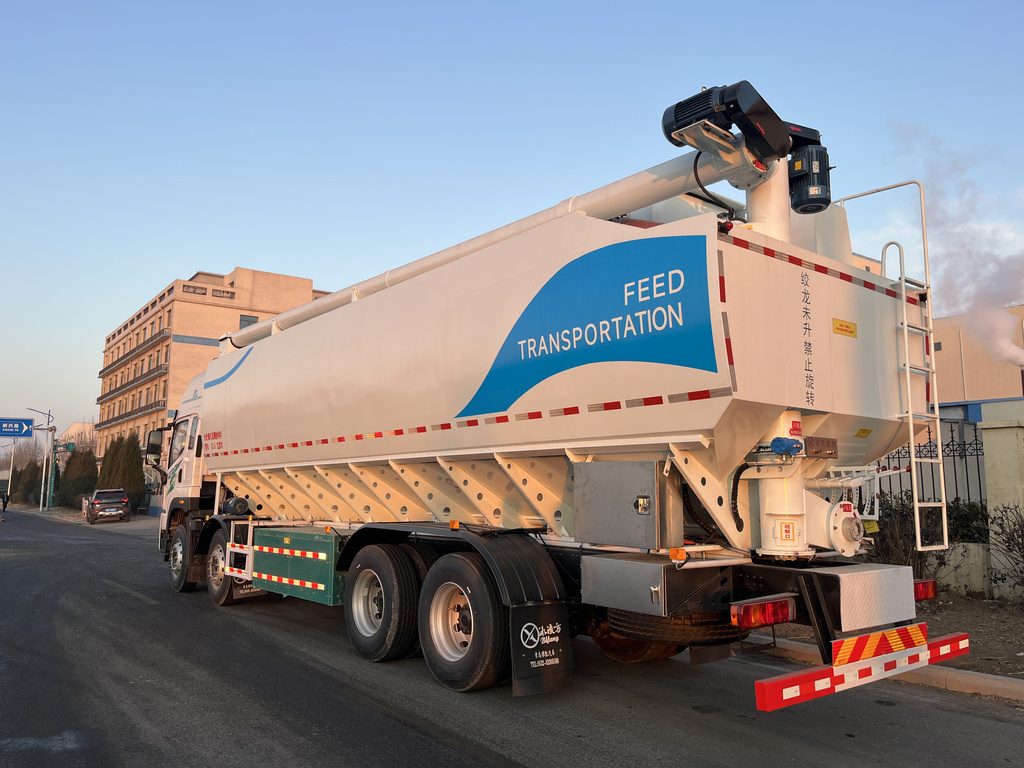
Axle Loads and Weight Distribution in Bulk Feed Trucks
In short: Axle load is the share of a truck's total weight carried by each axle, and it is limited separately from the vehicle's total weight. On a bulk feed truck the payload available for feed equals the allowable gross weight minus the tare weight of chassis and body. Because feed is dense and often carried in compartments that can be filled unevenly, correct compartment loading and periodic weighbridge checks matter more than on general haulage.


What Is an Axle Load Limit?
An axle load limit is the maximum weight a given axle, together with its tyres and suspension, is permitted to carry on the road. It is set by regulation and by the axle manufacturer, and it applies whether or not the truck is under its overall gross weight limit. A truck can be within its total weight limit and still be overloaded on one axle — a common finding on tankers and hopper bodies.
For a bulk feed truck, the practical consequences are direct. The vehicle has a gross vehicle weight rating (GVWR), which is the maximum all-up weight the chassis is approved for. Subtract the tare — chassis, body, fuel, driver and equipment — and you get the payload you may load as feed. That payload then has to be distributed across the axles so that no single axle or axle group exceeds its rating, and so that the steering axle keeps enough weight on it for safe control.
Key Facts at a Glance
- Payload is a subtraction — legal feed payload equals allowable gross weight minus tare weight, so every kilogram of body structure and equipment reduces what you can sell as delivery.
- Axles are rated separately — steering, drive and trailer axles each carry their own limit, and any one of them can be the binding constraint on a load.
- Centre of gravity moves with the load — a hopper body carries its mass high and often forward or rearward of the chassis midpoint, which makes distribution a design question as well as a loading question.
- Compartment filling changes the balance — filling the front compartment while leaving the rear empty shifts weight forward, and the reverse shifts it back.
- Liquid-like behaviour — dry feed settles and shifts during travel, so the distribution you set at the mill is not always the distribution you have at the farm.
- Weighbridge verification — a loaded check on a public or private weighbridge, axle by axle, is the standard way to confirm you are inside your limits.
Front-Loaded vs Rear-Loaded Compartment Filling
- Effect on the steering axle — Filling forward compartments adds weight to the steering axle and can approach its rating; filling rear compartments lightens the steering axle and can reduce steering grip.
- Effect on the drive axle — Rear-loaded bodies put more mass over the drive axle, improving traction on soft farm tracks; front-loaded bodies reduce it.
- Effect on handling — A load concentrated at the rear can make the truck feel light at the front, while a front-heavy load can make steering heavy and reduce brake balance.
- Effect on body structure — Long unsupported spans under a heavily loaded compartment stress the body shell; distributing load across compartments spreads that stress.
- Effect on unloading — The compartment emptied first changes the balance mid-route, so the sequence should be planned so the truck does not become unstable partway through the round.
- Effect on tyre and suspension wear — Concentrated loads wear tyres and suspension components on one axle faster than an evenly distributed load.
Step-by-Step: How to Load a Feed Truck Within Axle Limits
1. Find your true tare. Weigh the truck empty with a full fuel tank, driver, tools and any permanent equipment, so your payload calculation starts from the real number.
2. Confirm each axle rating. Check the plate and the chassis documentation for steering, drive and any tag or trailer axle ratings.
3. Plan the load per compartment. Decide how much feed goes into each compartment before loading, and check the resulting weight distribution rather than filling by eye.
4. Verify on a weighbridge. Weigh the loaded truck axle by axle, and adjust the compartment plan if any axle is close to its limit.
5. Load in the delivery order. Fill compartments so that the weight balance improves as the route progresses, rather than becoming more uneven after the first drop.
6. Recheck after the first drops. Weigh or estimate again once a compartment is empty, and adjust the remaining sequence if the truck becomes unbalanced.
FAQ
Q: How much feed can a bulk feed truck legally carry?
A: The legal payload is the allowable gross weight minus the truck's tare weight, and it is further limited by the lowest axle rating in the combination. Because both depend on your chassis and local regulations, check the vehicle plate and confirm on a weighbridge.
Q: Why is axle load different from total weight?
A: Total weight is summed across the vehicle, while each axle has its own limit. A truck can be under its gross limit and still exceed the rating of a single axle, which is why axle-by-axle weighing matters.
Q: Does compartment design affect legal payload?
A: It does. Dividers, extra outlets and discharge hardware add tare weight, which reduces the feed you can legally load. Compartment layout also affects how easily you can balance the load across axles.
Q: Can I load feed across a farm weighbridge?
A: If the site has a weighbridge, it is a useful check, but the legal reference is usually a certified public bridge. Keep documented weights for your fleet so you can show compliance if asked.
Q: What happens if a truck runs over its axle limit?
A: The risks are regulatory penalties, tyre and suspension damage, longer braking distances and poorer handling. Overloading also raises wear across the whole driveline.
Conclusion
Axle loading on a bulk feed truck is simple arithmetic with serious consequences: payload is what remains after tare, and no axle may exceed its rating. Get the tare right, plan the compartment fill rather than eyeballing it, and confirm with a weighbridge check. If you are specifying a body, tell the builder the chassis, the axle ratings and the bulk density of the feed you carry, so the body and compartment layout can be matched to your legal payload. Binglingfang builds bulk feed bodies to suit a range of chassis and payload requirements.
Refrigerated Truck Door Configurations: Rear, Side and Multi-Temperature Access
Sep 29, 2026
Heat Stress in Day-Old Chick Transit: Causes and Prevention
Sep 29, 2026
Related Articles
Author

Cybercoldchain
Content Writer
Recent Posts
-
GMP+ and FAMI-QS: Is Transport the Weak Link in Feed Safety?
Oct 31
-
Driver Shortages vs Delivery Windows: What Gives First?
Oct 31
-
Telematics for Bulk Feed: Is Bin-Level Data Worth the Investment?
Oct 31
-
Can Reefers Keep Up With 45°C+ Markets—or Do Specifications Need a Rethink?
Oct 31
-
The Hidden Cost of a Late Chick Delivery—Who Should Bear It?
Oct 31