
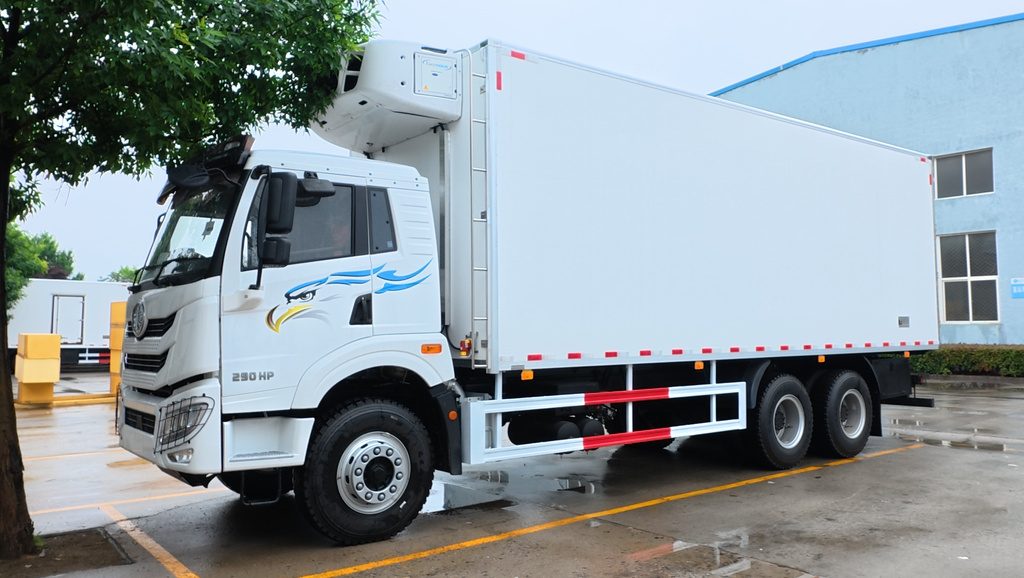
How to Match a Cooling Unit to Your Refrigerated Truck Body
In short: Matching a cooling unit is not about picking the largest available model. It is about five inputs: the product temperature you must hold, the internal volume of the box, the quality of the insulation, how often the doors open, and the ambient conditions on your route. Get those five written down and the correct capacity range becomes obvious.


What Is Cooling Unit Sizing?
Cooling unit sizing is the process of choosing a refrigeration unit whose capacity can pull the box down to set point and then hold it, under your real operating conditions. Two different jobs hide inside one word. Pull-down is the energy needed to bring a warm box and warm product to temperature. Holding is the energy needed to remove heat that leaks in through the panels and enters every time a door opens.
A unit that holds well but pulls down slowly will cost you time at the start of every shift. A unit sized with margin handles both, but excessive margin adds weight and purchase cost without improving the temperature you deliver.
Key Facts at a Glance
- Chilled distribution runs at 0 to 4 degrees Celsius; frozen distribution runs at around minus 18 degrees Celsius. The lower the set point, the more work the unit does.
- Better insulation directly reduces unit load. Polyurethane integral foam cores are commonly quoted with a closed-cell rate of 95 percent or higher and a thermal conductivity of about 0.022 W/(m·K), quoted as product parameters.
- Panel thickness is a sizing variable, not just a comfort feature. Thicker walls, floor and roof reduce heat gain and can allow a smaller unit.
- Door openings are a major load. A body on a multi-stop route gains far more heat per hour than a body on one long trunk run.
- A 4.2 m refrigerated body can be built at roughly 670 kg, so a heavier cooling unit plus heavier panels has a measurable effect on payload.
- Both FRP sandwich and polyurethane integral foam bodies are mature constructions and both can be specified with the panel thickness your temperature band requires.
A vs B: Chilled-Duty vs Frozen-Duty Specification
- Temperature target — Chilled duty holds 0 to 4 degrees Celsius for fresh product; frozen duty holds around minus 18 degrees Celsius and needs more capacity for the same box.
- Pull-down demand — Chilled loads can often be pre-cooled and loaded cool; frozen loads usually need a deeper pull-down and better door discipline to stay at set point.
- Insulation thickness — Chilled boxes tolerate thinner panels; frozen boxes benefit from thicker panels and tighter sealing because the temperature gap to ambient is larger.
- Door management — Chilled routes can accept more door openings per shift; frozen routes are more sensitive, so side doors and strip curtains matter more.
- Payload effect — The frozen specification generally adds weight through thicker panels and a larger unit, which reduces the cargo you can legally carry on the same chassis.
Step-by-Step: How to Size a Cooling Unit
1) Write down the product temperature band. Decide whether the load is chilled at 0 to 4 degrees Celsius, frozen near minus 18 degrees Celsius, or a mixed load that may need compartments.
2) Calculate internal volume, not external size. Use the real internal dimensions of the box after insulation thickness is subtracted, because that is the air volume the unit must move.
3) Note the insulation specification. Record panel thickness for walls, floor and roof, plus the core material, so the heat gain estimate is based on what is actually being built.
4) Estimate door openings per shift. Count drops, their duration and whether a side door or a curtain is used. Frequent access is one of the most common reasons a correctly sized unit appears to underperform.
5) Add a sensible margin for ambient conditions. Summer temperatures, direct sun on the roof and long idling periods all push demand upward, so leave room rather than sizing to the average day.
6) Confirm the practical details before ordering. Check electrical supply, defrost method, unit weight, and whether the body builder and the unit supplier have agreed on the mounting.
FAQ
Q: Can I run a frozen box with a unit sized for chilled work?
A: It will hold temperature only under light duty and will struggle during pull-down or on hot days. Frozen duty needs more capacity because the temperature gap to ambient is larger. Size for the coldest product you intend to carry, not the average of the year.
Q: Does better insulation mean I can buy a smaller unit?
A: Often yes, within limits. Reduced heat gain lowers the holding load, but pull-down and door loss still demand capacity. Insulation and unit sizing should be decided together rather than one after the other.
Q: How do I know if my unit is undersized?
A: Typical signs are a long pull-down at the start of the day, temperature rising during multi-stop routes, and running continuously without reaching set point in hot weather. Check gaskets and door discipline first, because those are cheaper to fix than capacity.
Q: Should I leave the unit running during unloading?
A: It depends on the unit and the route. Many operators keep it running with the doors closed between drops and switch to a standby mode where available. What matters is avoiding long periods with doors open and the unit off.
Q: Do side doors change sizing?
A: They change how you operate more than how you size. Side doors reduce the time each door stays open, which lowers heat gain per stop, but they also add another sealing surface to maintain. Plan access first, then confirm capacity.
Conclusion
Cooling unit sizing is a short calculation built on five honest inputs: temperature band, internal volume, insulation specification, door frequency and ambient conditions. Bodies built with FRP sandwich panels or with polyurethane integral foam both support that calculation, and the thickness you choose is part of it. Before you order, put the five inputs in writing and ask the builder and the unit supplier to confirm they agree on the same numbers.
Compartment Design for Multiple Feed Formulas in Bulk Feed Trucks
Sep 29, 2026
Cleaning Between Feed Types: Cross-Contamination Control in Bulk Trucks
Sep 29, 2026
Related Articles
Author

Cybercoldchain
Content Writer
Recent Posts
-
GMP+ and FAMI-QS: Is Transport the Weak Link in Feed Safety?
Oct 31
-
Driver Shortages vs Delivery Windows: What Gives First?
Oct 31
-
Telematics for Bulk Feed: Is Bin-Level Data Worth the Investment?
Oct 31
-
Can Reefers Keep Up With 45°C+ Markets—or Do Specifications Need a Rethink?
Oct 31
-
The Hidden Cost of a Late Chick Delivery—Who Should Bear It?
Oct 31