
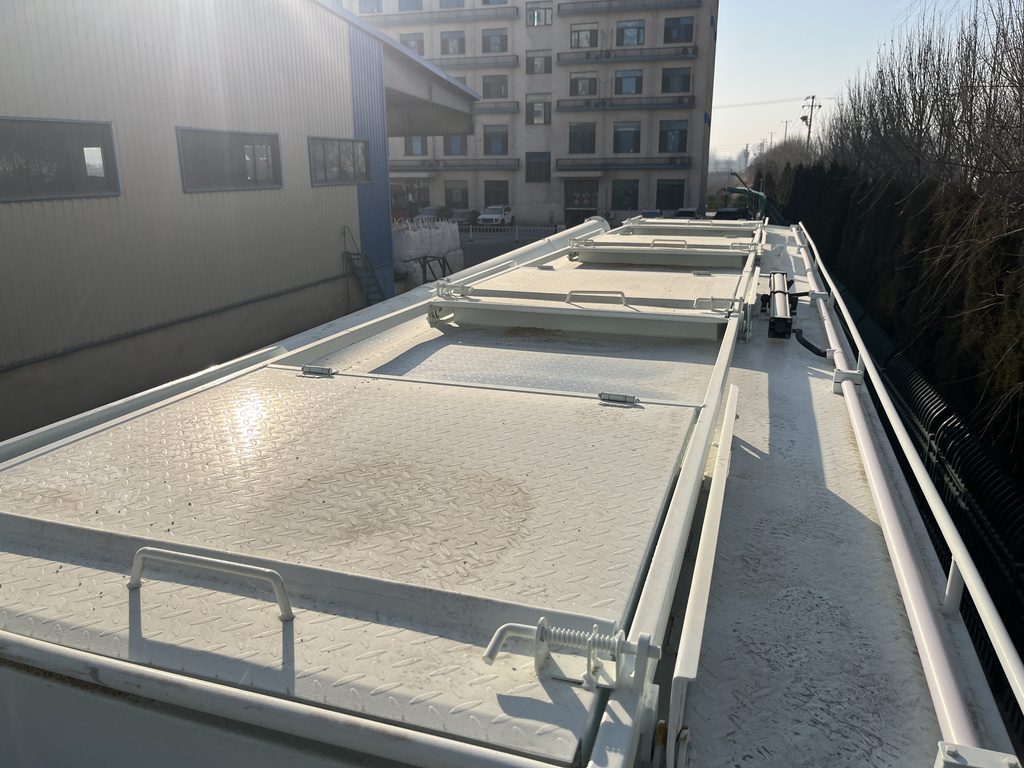
Compartment Design for Multiple Feed Formulas in Bulk Feed Trucks
In short: Multi-compartment bulk feed trucks carry several feed formulas on one chassis by splitting the hopper body into separate bins, each with its own divider, outlet and discharge line. Compartment count is set by how many rations a customer needs per trip; the critical design details are divider height, outlet clearance, discharge order and clean-out access, because those decide how cleanly formulas stay apart and how easily the body is cleaned between them.


What Is a Multi-Compartment Feed Body?
A multi-compartment feed body is a bulk feed hopper divided by internal walls — often called dividers or baffles — into two or more independent bins. Each compartment holds a different formula, such as a starter ration, a grower ration, and a medicated blend, and each has its own outlet and its own path through the discharge system.
The point of the design is to serve several bins at one farm, or several customers on one route, without the truck returning to the mill between deliveries. But the more compartments a body carries, the more structure, hardware and clean-out work it has, so compartment count is a trade-off rather than a simple upgrade. The phrase "drop in the same trip" matters: a farm that orders three rations weekly is a strong candidate for a three-compartment body, while a farm that takes one ration does not benefit at all.
Key Facts at a Glance
- Divider walls — each compartment is separated by a full-height divider; dividers must reach the top of the body to prevent feed from one bin spilling into the next during loading or travel.
- Independent outlets — every compartment needs its own outlet at the low point of the hopper, feeding either its own discharge line or a shared line that can be switched.
- Sloped floors — compartment floors are sloped toward the outlet so feed drains under gravity; a shallow slope leaves residue packed in the corner.
- Clean-out access — inspection hatches, removable covers and reachable interior corners decide how practical cleaning between recipes will be.
- Load plan — compartments are loaded in a planned order so that the ration delivered last is not buried behind the ration delivered first.
- Sequence control — the discharge order follows the route, with the first drop usually served from the compartment that empties fastest.
Single Bin vs Multi-Compartment Design
- Rations per trip — A single bin carries one formula and needs a mill return to switch product; a multi-compartment body carries two or more formulas on the same load.
- Structure and weight — A single bin is simpler and lighter, leaving more payload for feed; compartments add divider plates, extra outlets and hardware, which reduce payload slightly.
- Cross-contamination risk — A single bin has no internal boundary to fail, but every recipe change requires a full clean; multi-compartment bodies limit contact between formulas but add divider edges and corners where residue collects.
- Loading time — A single bin fills through one hatch quickly; a multi-compartment body takes longer because each compartment is filled separately and checked individually.
- Delivery flexibility — A single bin suits one-stop routes and single-ration farms; compartments allow multi-drop routes and farms that order several rations per visit.
- Cleaning workload — A single bin cleans in one pass; each compartment must be cleaned and inspected separately, so labour per load rises with compartment count.
- Cost and complexity — A single bin is the lower-cost option; compartments raise both purchase cost and the number of seals, gates and moving parts to maintain.
Step-by-Step: How to Plan Compartment Layout
1. Count the rations per drop. Review your customers' weekly orders and identify the farms that order two or more formulas in one visit — those determine minimum compartment count.
2. Map the delivery sequence. Write the route in order of stops and match each stop to a compartment, so the truck empties in a sequence that avoids shuffling feed between bins.
3. Check divider and outlet geometry. Confirm each divider reaches the top of the body and that every compartment floor slopes to its own outlet without leaving a dead corner.
4. Plan the loading order. Decide which compartment is filled first and which is filled last, and make sure the hatches allow that order without cross-spill.
5. Design the clean-out route. For each compartment, work out how an operator reaches every interior surface, including the top of the dividers and the outlet throat.
6. Confirm weight and axle limits. Distribute compartments so the loaded weight sits correctly on the axles and stays within your legal payload and axle ratings.
FAQ
Q: How many compartments should a bulk feed truck have?
A: As many as your routes genuinely need and no more. Base the count on the highest number of formulas a single customer orders per visit, then check that the extra divisions do not push you past your legal payload.
Q: Do compartments prevent cross-contamination completely?
A: They limit it, but they do not eliminate it. Residue can sit along divider edges, at gate seals and in the discharge line, so a cleaning routine between incompatible recipes is still necessary.
Q: Can I carry medicated feed in one compartment and plain feed in another?
A: Yes, with care. Medicated feed is usually given a dedicated compartment, a documented clean-down routine, and a discharge sequence that keeps it away from other rations. Follow your local feed regulations on sequencing and cleaning.
Q: Does adding compartments reduce payload?
A: It does, because divider plates, extra outlets and gates add structural weight. The reduction is modest on a large body but worth checking against your payload allowance before you commit.
Q: How do I deliver several formulas to one farm?
A: Deliver in the order the farm needs them, using the compartment whose contents you want to keep cleanest last. Confirm the on-farm bin sequence with the customer before the truck leaves the mill.
Conclusion
Compartment design is really route design in metal. The number of dividers, the position of each outlet and the sequence you unload in all follow from how your customers order feed, not from a catalogue figure. Get the loading order and clean-out access right and a multi-compartment body will cut trips and keep formulas apart. Binglingfang builds bulk feed bodies in several compartment arrangements, so it helps to bring your route list and ration counts to the specification conversation.
Bulk Feed Discharge Systems Compared: Pneumatic, Auger and Gravity
Sep 29, 2026
How to Match a Cooling Unit to Your Refrigerated Truck Body
Sep 29, 2026
Related Articles
Author

Cybercoldchain
Content Writer
Recent Posts
-
GMP+ and FAMI-QS: Is Transport the Weak Link in Feed Safety?
Oct 31
-
Driver Shortages vs Delivery Windows: What Gives First?
Oct 31
-
Telematics for Bulk Feed: Is Bin-Level Data Worth the Investment?
Oct 31
-
Can Reefers Keep Up With 45°C+ Markets—or Do Specifications Need a Rethink?
Oct 31
-
The Hidden Cost of a Late Chick Delivery—Who Should Bear It?
Oct 31