
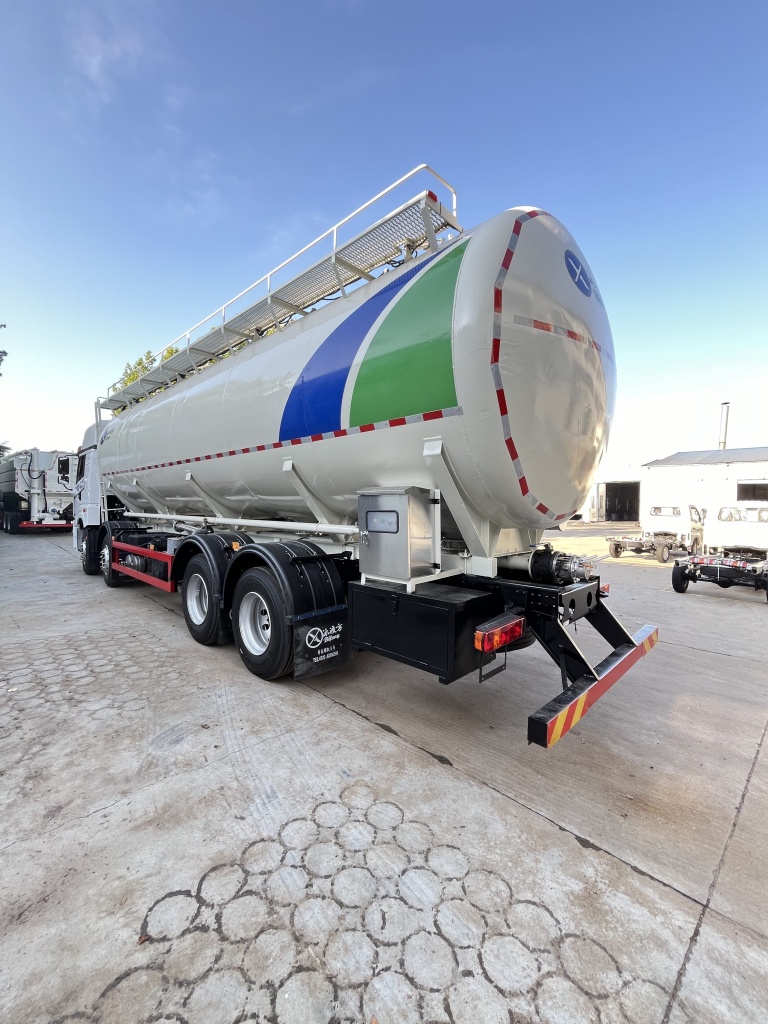
Bulk Feed Discharge Systems Compared: Pneumatic, Auger and Gravity
In short: Bulk feed trucks unload by one of three methods — pneumatic air conveying, mechanical auger conveying, or gravity flow. Pneumatic offers the longest reach and the easiest access to awkward sites, augers give moderate reach at lower cost, and gravity is the simplest and lightest option when the truck can park beside the bin. Most fleets decide on site layout rather than tonnage.


What Is a Bulk Feed Discharge System?
A bulk feed discharge system is the set of hopper outlets, conveyors, blowers and delivery lines that moves feed from the truck body into a customer's storage bin. It begins at the bottom of each compartment, where feed falls onto a metering device, and ends where feed drops into the bin inlet.
The discharge system decides how far a truck can stand from a bin, how much feed stays behind in the body after unloading, how much engine power the delivery draws, and how much routine maintenance the operator faces. The three mainstream architectures are pneumatic (air) discharge, mechanical auger or chain conveyor discharge, and gravity discharge. Many bodies combine them — for example, a sloped gravity floor feeding a cross auger, which then feeds an inclined delivery auger.
Key Facts at a Glance
- Pneumatic — feed is metered into a moving airstream and blown through a flexible hose, so the truck can stay on the road while feed travels to a distant or elevated bin.
- Auger — a rotating screw inside a tube carries feed from the body outlet, with reach extended by adding tube sections in line.
- Gravity — feed flows down a sloped hopper floor and out through a bottom or rear outlet under its own weight.
- Power source — pneumatic blowers are commonly driven by a power take-off from the chassis engine or by a dedicated engine; augers usually run hydraulically or electrically.
- Residue — every system leaves some feed behind; smooth interiors, adequate floor slope and a clean-out routine reduce carryover between loads.
- Maintenance surface — pneumatic adds blower, airlock and hose points; augers add flights, bearings and drives; gravity has the fewest moving parts.
Pneumatic vs Auger vs Gravity
- Reach — Pneumatic blows feed through a hose and can reach tall silos set back from the road; an auger reaches a shorter distance but accepts extra tube sections; gravity needs the truck parked alongside the bin.
- Site access — Pneumatic suits tight yards and awkward approaches because the truck itself stays on firm road; auger needs a clear line for the tube; gravity needs the bin inlet directly within reach of the outlet.
- Purchase cost — Gravity is the simplest and lowest-cost configuration; auger sits in the middle; pneumatic carries the highest equipment cost because of blower, airlock and piping.
- Weight on the chassis — Gravity is the lightest, leaving more legal payload for feed; auger adds conveyor hardware; pneumatic adds blower, airlock and piping mass.
- Unloading control — Pneumatic allows fine flow control at the bin through blower throttle; auger flow follows conveyor speed; gravity is essentially flowing or stopped.
- Maintenance and skills — Gravity asks the least attention; augers need flight and bearing checks; pneumatic rewards operators who understand airlocks, seals and blower service.
- Dust at the drop point — Pneumatic delivery can raise more airborne dust where feed enters the bin; gravity and auger produce less.
- Power draw — Pneumatic generally draws more engine power because the blower runs throughout discharge.
Step-by-Step: How to Choose a Discharge System
1. Map your customer sites. List every regular delivery point and note how far the bin sits from where a truck can park, plus the height of the bin inlet.
2. Size to the hardest site. Specify around the most difficult site you must serve, because the fleet has to cover the whole route, not just the easy stops.
3. Check legal payload. Subtract the weight of the discharge hardware from your allowable payload and confirm the body still carries the feed volume your routes require.
4. Review workshop capability. If your team is comfortable with hydraulics and blowers, pneumatic is manageable; if not, weigh the value of a simpler layout.
5. Match the product mix. Fine, dusty and pelleted feeds behave differently in each system, and some recipes convey more gently by auger than by air.
6. Pilot one truck first. Run a single unit on your hardest route for a season, compare cycle times and residue, then standardise across the fleet.
FAQ
Q: Is pneumatic discharge faster than gravity?
A: Not universally. Gravity unloads quickly once the truck is parked beside the bin, while pneumatic takes longer per tonne in easy conditions but reaches bins that gravity cannot. The faster option in practice is the one that matches your sites.
Q: Can one truck use more than one discharge method?
A: Yes. Many bodies combine a sloped gravity floor with a cross auger, or pair a gravity outlet with an air line for distant bins. Combined layouts add flexibility, but also add weight and maintenance points.
Q: Does the discharge method affect feed quality?
A: It can. Air conveying moves feed quickly through a pipe, which may increase attrition on fragile pellets, while augers create mechanical contact along the flights. Gentle handling matters most when you deliver crumbles or medicated feed.
Q: How do I handle leftover feed between loads?
A: Run the system empty at the end of each delivery, open the clean-out points, and brush or sweep the hopper interior. Smooth interior surfaces and a good floor slope make this routine quick.
Q: Which system suits a mixed fleet?
A: Many operators run gravity or auger bodies on routine farm routes and keep one pneumatic unit for tall silos and hard-to-reach bins.
Conclusion
Pneumatic, auger and gravity discharge are all proven layouts, and none of them is inherently wrong — the right choice follows your customers' bin positions, your payload target, and what your workshop can maintain. Start from your hardest delivery site and work backwards from there. If you are specifying a bulk feed body, Binglingfang builds these discharge arrangements on a choice of compartment layouts, and a short conversation about your routes is usually enough to narrow the options.
Day-Old Chick Transport Route Planning: Timing, Stops and Rest Breaks
Sep 29, 2026
Compartment Design for Multiple Feed Formulas in Bulk Feed Trucks
Sep 29, 2026
Related Articles
Author

Cybercoldchain
Content Writer
Recent Posts
-
GMP+ and FAMI-QS: Is Transport the Weak Link in Feed Safety?
Oct 31
-
Driver Shortages vs Delivery Windows: What Gives First?
Oct 31
-
Telematics for Bulk Feed: Is Bin-Level Data Worth the Investment?
Oct 31
-
Can Reefers Keep Up With 45°C+ Markets—or Do Specifications Need a Rethink?
Oct 31
-
The Hidden Cost of a Late Chick Delivery—Who Should Bear It?
Oct 31