
Day-Old Chick Transport Route Planning: Timing, Stops and Rest Breaks
Day-Old Chick Transport Route Planning: Timing, Stops and Rest Breaks
In short: Day-old chick transport route planning means building your driving schedule around what the birds need: travel in the cooler parts of the day, keep the journey short and steady, and stop only when the stop earns its place. On long routes, a constant-temperature chick truck with active cooling and ventilation gives you far more timing freedom than a ventilated truck that depends on airflow alone.
What Is Day-Old Chick Transport Route Planning?
Route planning for day-old chicks is the process of deciding departure time, road route, rest breaks and arrival window so the birds stay inside a comfortable temperature and air-quality range from hatchery to farm. It combines ordinary logistics — distance, traffic, driver hours, tolls — with one biological constraint that overrides all of them: a chick in a box cannot cool itself. It has no sweat glands worth the name and only limited ability to pant. Once the load is on board, the truck is the birds' entire climate. Planning therefore means fitting the schedule to the load, not the load to the schedule.


Key Facts at a Glance
- Constant-temperature chick trucks hold an interior target of 22–26 °C and control CO₂ at no more than 3,000 ppm, with 2,800 ppm as the working target.
- Those trucks are rated for ambient conditions from −35 °C to +40 °C, which matters when a route crosses climate zones or seasons.
- Chick boxes measure 640 × 480 × 170 mm, and that footprint decides how many boxes fit and how much airflow space is left over.
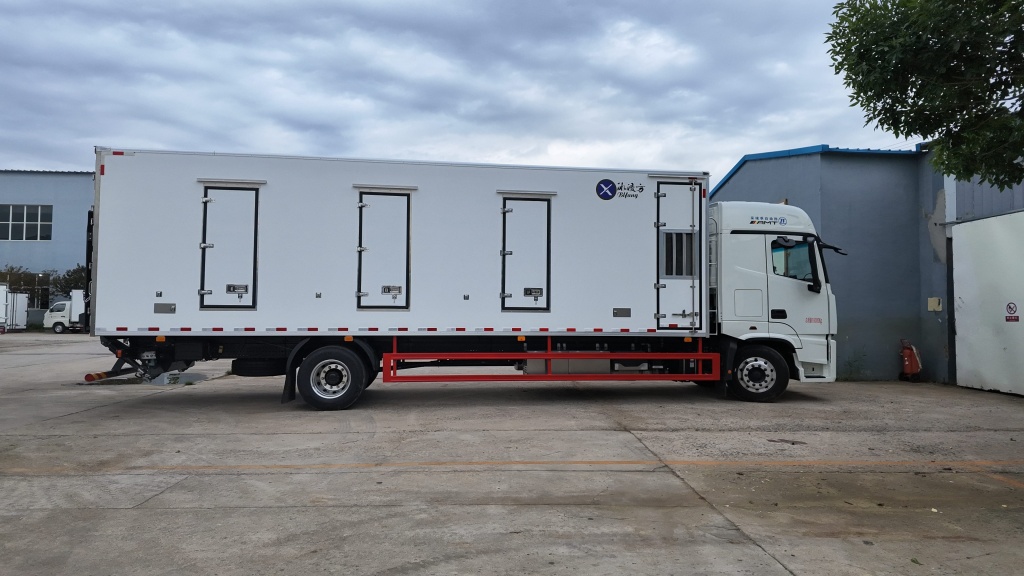
- Ventilated chick trucks run from 4.2 m to 9.6 m and carry 232 to 672 boxes depending on body length, using fans and ventilation windows rather than active cooling.
- A 9.6 m constant-temperature chick truck carries 624 boxes — 24 trolleys at 26 boxes each — with a hydraulic tail lift as standard equipment.
Ventilated Truck vs Constant-Temperature Truck for Route Planning
- Trip distance — A ventilated truck suits shorter and moderate routes where outside air can do most of the work; a constant-temperature truck is built for long hauls and for hot or cold weather.
- Departure window — Ventilated trucks push you toward early-morning or evening departures to avoid peak heat; constant-temperature trucks let you run the schedule the hatchery and the farm actually agreed on.
- Stop tolerance — A ventilated truck loses its advantage quickly during any long stationary stop; a constant-temperature truck with an independent engine keeps cooling and circulating while parked.
- Seasonal flexibility — A ventilated truck may need auxiliary heating in winter and offers only limited cooling in summer; a constant-temperature truck covers the full −35 °C to +40 °C envelope with its own systems.
- Route risk — Traffic jams, ferry queues and road closures punish a passive truck far more than an actively controlled one.
Step-by-Step: How to Plan a Chick Transport Route
1) Fix the arrival window first, then work backwards. Start from the time the farm can receive and unload, subtract driving time, loading time and planned breaks, and that gives you your departure slot. Deciding departure first and hoping for a good arrival time is how delays become bird stress.
2) Check the weather along the entire corridor, not just at both ends. A cool morning at the hatchery means little if the route crosses a hot valley at midday. Note the forecast highs and whether you will be sitting in traffic during the hottest hours.
3) Choose roads for reliability, not just distance. A slightly longer motorway route with steady speed often beats a shorter one with stop-start traffic and long signals. Fewer stops means fewer moments where airflow drops and the box interior heats up.
4) Plan stops deliberately and keep them short. Fuel, driver rest and inspections should be combined where possible. Park in shade, never leave the load in direct sun, and remember that a stationary ventilated truck warms quickly. Driver rest breaks are a legal requirement in most markets and should be built into the plan, not improvised.
5) Set inspection checkpoints. Mark two or three points on the route where the driver checks temperature display, airflow, and load security. A checkpoint every few hours catches a shifted load or a closed vent long before arrival.
6) Prepare a fallback for the two most likely failures. Know where the nearest alternative route is if a road closes, and know your contingency if a fan or cooling system misbehaves — which, on a constant-temperature truck, means the chassis generator feeding the fans plus roughly two hours of battery supply while you drive to the nearest safe point.
FAQ
Q: How long can day-old chicks travel?
A: Day-old chicks are usually delivered within a few hours, and long-haul deliveries are planned as tightly as possible. There is no universal limit — it depends on outside temperature, load density, ventilation and truck type. Active cooling and ventilation are what make long routes practical.
Q: Is it better to drive at night or early morning?
A: In warm climates and warm seasons, yes. Cooler ambient air reduces the load on ventilation and cooling, and traffic is lighter, which means fewer stationary periods. In cold weather the calculation flips — you then need to protect against chilling rather than heat, and a heated or constant-temperature truck becomes the priority.
Q: Do I need a constant-temperature truck for every route?
A: No. Short and moderate routes in mild weather are well served by a ventilated chick truck with fans and ventilation windows. The case for a constant-temperature truck gets stronger as distance, heat, cold or schedule pressure increase.
Q: How often should the driver check the load en route?
A: Plan checks at each fuel or rest break, plus any checkpoint you marked during planning. Confirm airflow is running, vents are as set, and the load has not shifted onto air paths.
Conclusion
Route planning is where chick transport succeeds or fails, because temperature control is a function of time as much as of equipment. Fix the arrival window, read the whole corridor's weather, choose reliable roads, and treat every stop as a risk that must be justified. Match the truck to the route: ventilated for short and moderate runs, constant-temperature when distance, climate or schedule leave no margin. Binglingfang has built specialized vehicles since 1991; if you are comparing options for a specific route, our team can help you check the fit.
Day-Old Chick Loading Density: How to Calculate Boxes per Truck
Sep 29, 2026
Bulk Feed Discharge Systems Compared: Pneumatic, Auger and Gravity
Sep 29, 2026
Related Articles
Author

Cybercoldchain
Content Writer
Recent Posts
-
GMP+ and FAMI-QS: Is Transport the Weak Link in Feed Safety?
Oct 31
-
Driver Shortages vs Delivery Windows: What Gives First?
Oct 31
-
Telematics for Bulk Feed: Is Bin-Level Data Worth the Investment?
Oct 31
-
Can Reefers Keep Up With 45°C+ Markets—or Do Specifications Need a Rethink?
Oct 31
-
The Hidden Cost of a Late Chick Delivery—Who Should Bear It?
Oct 31