
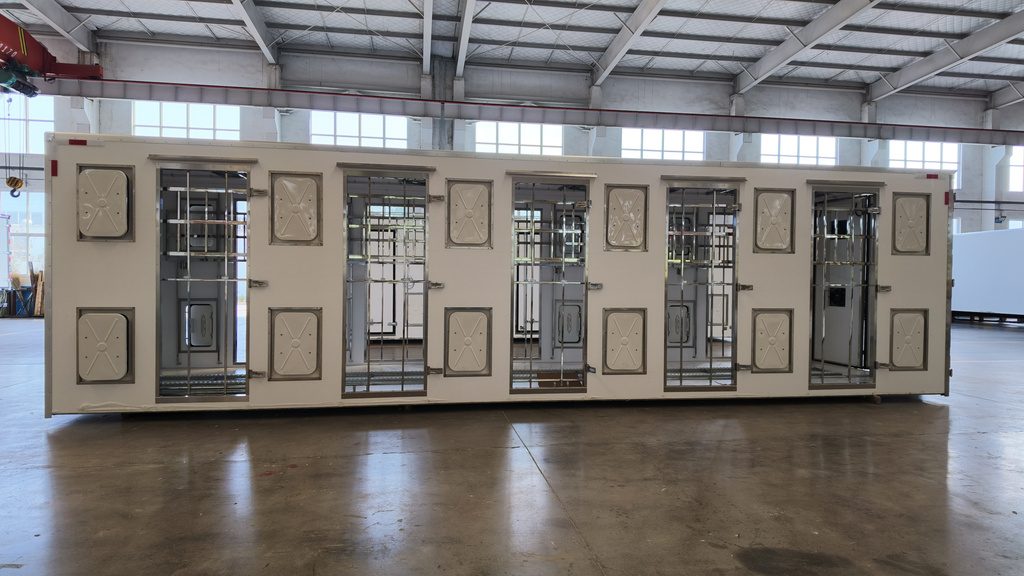
Day-Old Chick Loading Density: How to Calculate Boxes per Truck
In short: Chick loading density is the number of chick boxes you place in a given truck volume, and the correct figure is the highest number that still leaves clear airflow lanes. A standard chick box measures 640 × 480 × 170 mm, and a ventilated chick truck carries 232 boxes at 4.2 m, 464 at 6.8 m, 536 at 7.8 m and 672 at 9.6 m — but only if you load in a planned pattern rather than filling every gap.


What Is Chick Loading Density?
Chick loading density is the count of day-old chick boxes loaded into a truck, expressed either as a total for the vehicle or as boxes per unit of floor area. It sits at the intersection of two competing needs. Economics push the number up, because every box you leave behind is capacity you paid for and did not use. Bird welfare pushes it down, because each box blocks air from reaching the boxes around it. Density calculation is therefore not a single multiplication — it is a loading pattern decision that produces a number.
Key Facts at a Glance
- The standard chick box size used for capacity planning is 640 × 480 × 170 mm.
- Ventilated chick truck capacity by body length: 4.2 m = 232 boxes, 6.8 m = 464 boxes, 7.8 m = 536 boxes, 9.6 m = 672 boxes.
- Those totals already assume side stacks plus a centre line of boxes, with lanes left open rather than a solid block.
- A 9.6 m constant-temperature chick truck carries 624 boxes, loaded as 24 trolleys with 26 boxes each, and comes with a hydraulic tail lift as standard.
- Constant-temperature trucks are offered in 6.8 m, 7.8 m and 9.6 m body lengths, with longer bodies preferred for their better value per box in domestic operation.
Free-Stacked Boxes vs Trolley-Loaded Boxes
- Loading speed — Free-stacked boxes go in by hand and are quick for small loads; trolley loading is faster and more controlled once volumes are high.
- Airflow control — Free stacking lets you shape lanes box by box; trolleys create fixed gaps that are consistent but less adjustable.
- Density per metre — Hand stacking can edge closer to the maximum; trolley systems trade a small amount of space for speed and less manual handling.
- Handling effort — Free stacking is heavy manual work throughout the load; trolleys concentrate the effort into a few moves with a tail lift.
Step-by-Step: How to Calculate Boxes per Truck
1) Start from the usable floor area, not the external body size. Measure the internal floor length and width. External dimensions include wall thickness and body framing, so using them will overstate capacity every time.
2) Divide the floor into lanes. A standard pattern is a right-hand stack, a left-hand stack and a centre line, with a gap between them. Work out how many boxes fit across the width of each lane when the box's long side runs fore-and-aft.
3) Calculate boxes per lane position. For each lane, divide the lane length by the box length along the truck. Round down. Never round up — a box that does not fit gets jammed and blocks the lane behind it.
4) Work out the number of layers. Divide the usable internal height by the box height of 170 mm, then subtract one layer if the top layer would sit against the roof and close off the top air path. A layer of clearance above the load is what lets warm air leave.
5) Multiply and then subtract for airflow. Multiply boxes per layer by the number of layers, then reserve the gaps you need: a vertical channel through the load, and clearance at the front so air from the fans can enter. This is why published capacity figures are already below a pure geometric maximum.
6) Verify against the door and the tail lift. Check the rear door opening height and width, and confirm the tail lift platform handles your trolley weight. Capacity you cannot get through the door is not capacity.
FAQ
Q: Why does the same body length give different box counts between truck types?
A: Because capacity depends on the internal layout, not only on length. A 9.6 m ventilated truck is rated at 672 boxes in a free-stacked pattern, while a 9.6 m constant-temperature truck is rated at 624 boxes because the equipment and trolley system take up space and the loading pattern is fixed.
Q: Can I load more boxes if I skip the airflow lanes?
A: You can, but you are trading airflow for count, and the boxes in the middle of a solid block will be the first to overheat. Published capacity figures already leave lanes open, which is why they are the number to plan around.
Q: Does box size vary enough to matter?
A: Yes. The 640 × 480 × 170 mm box is the size used for these capacity figures, but hatcheries use other formats too. If your boxes differ, recalculate from your actual dimensions.
Q: How do I know if I have overloaded?
A: The clearest signs are boxes packed tight with no visible gaps, vents or fans blocked by stacks, and no clearance at the front of the load. If you cannot see a continuous air path from the front of the truck to the rear, you have loaded past the useful density.
Q: Does density change for a constant-temperature truck?
A: The principle is the same, but the truck controls the climate actively, so the risk shifts from immediate heat build-up to airflow distribution within the load. The trolley pattern is designed to keep a consistent path for air and to make checks quicker.
Conclusion
Correct loading density is the count that fills the truck without closing the air paths. Measure the internal floor, divide into lanes, work out layers against the 640 × 480 × 170 mm box, then reserve space for airflow and the door opening. The result should land near the published figures — 232 boxes at 4.2 m through to 672 at 9.6 m for ventilated trucks, or 624 boxes for a 9.6 m constant-temperature truck. Binglingfang has manufactured specialized vehicles since 1991; if you tell us your box dimensions and route, we can help you check the loading plan against the body you are considering.
Heat Stress in Day-Old Chick Transit: Causes and Prevention
Sep 29, 2026
Day-Old Chick Transport Route Planning: Timing, Stops and Rest Breaks
Sep 29, 2026
Related Articles
Author

Cybercoldchain
Content Writer
Recent Posts
-
GMP+ and FAMI-QS: Is Transport the Weak Link in Feed Safety?
Oct 31
-
Driver Shortages vs Delivery Windows: What Gives First?
Oct 31
-
Telematics for Bulk Feed: Is Bin-Level Data Worth the Investment?
Oct 31
-
Can Reefers Keep Up With 45°C+ Markets—or Do Specifications Need a Rethink?
Oct 31
-
The Hidden Cost of a Late Chick Delivery—Who Should Bear It?
Oct 31