
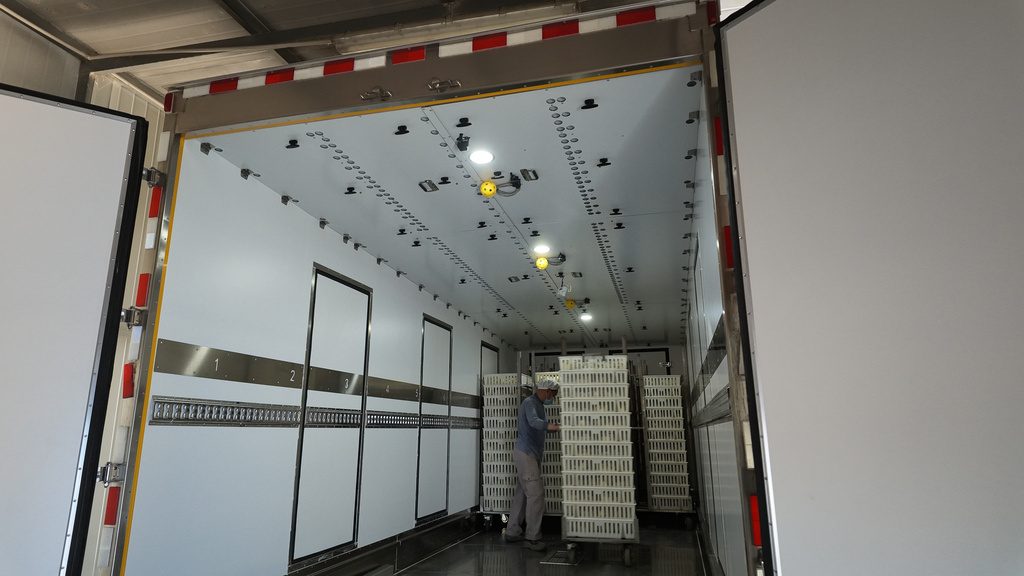
Heat Stress in Day-Old Chick Transit: Causes and Prevention
In short: Heat stress in day-old chick transit happens when the air around the birds carries away less heat than they produce. The usual causes are insufficient airflow, over-dense loading, blocked vents and long stationary periods in the sun. Prevention means keeping air moving, keeping the load loose enough for that air to reach every box, and matching the truck to the route — 22–26 °C with CO₂ held at or below 3,000 ppm is the control target on a constant-temperature chick truck.


What Is Heat Stress in Chick Transport?
Heat stress is the condition where a chick's body can no longer balance the heat it generates against the heat it can lose to its surroundings. Day-old chicks arrive from the hatchery with limited thermoregulation and, packed in a box, they generate heat continuously. In a properly ventilated load, moving air removes that heat and carries off the CO₂ the birds exhale. When airflow falls short, both temperature and CO₂ rise together, and the birds have no way to escape the box they are in. That is why the problem is nearly always an airflow problem before it is a temperature problem.
Key Facts at a Glance
- The control target inside a constant-temperature chick truck is 22–26 °C, with CO₂ held at no more than 3,000 ppm and 2,800 ppm as the working target.
- Constant-temperature chick trucks are rated for outside conditions from −35 °C to +40 °C, so the systems are built for weather extremes in both directions.
- Ventilated chick trucks use fans plus ventilation windows and side doors; an auxiliary air-conditioning unit can be fitted but its cooling effect is limited.
- Body lengths run 4.2 m, 6.8 m, 7.8 m and 9.6 m, carrying 232, 464, 536 and 672 boxes respectively when loaded with the standard 640 × 480 × 170 mm chick box.
- The chick box itself is a closed volume. Air reaches the birds through the openings in the box and through the gaps left between boxes during loading.
Ventilated Truck vs Constant-Temperature Truck in Hot Weather
- Cooling source — A ventilated truck relies on ambient air moved by fans; a constant-temperature truck uses an independent engine and active cooling.
- Peak heat performance — A ventilated truck's ability to cool is bounded by outside air temperature; a constant-temperature truck holds its 22–26 °C target across a −35 °C to +40 °C ambient range.
- Standing time — A parked ventilated truck has no cooling when airflow stops; a constant-temperature truck keeps running its systems while stationary.
- Auxiliary AC — Optional air conditioning on a ventilated truck has limited effect and is not a substitute for active climate control.
- Where each fits — Ventilated trucks suit short, mild-condition runs; constant-temperature trucks suit long hauls, hot seasons and tight delivery windows.
Step-by-Step: How to Prevent Heat Stress in Transit
1) Load to the density that keeps air paths open. Do not fill every gap. Keep the side stacks and centre line pattern with clear lanes between them, and leave the front of the load clear so air reaching the box can distribute through the whole cargo.
2) Check every vent, fan and window before departure. Confirm ventilation windows are open as required, fan guards are clear of fluff, and the front air intakes are unobstructed. On hot days, the rear door louvres work with the front intakes to create a through-flow of air along the length of the box.
3) Time the run around the heat. Depart in the early morning or evening when ambient temperatures are lowest and traffic is lighter.
4) Never park the load in direct sun. During fuel stops or driver rest breaks, park in shade where possible and keep the ventilation running.
5) Monitor inside the box, and know when the truck is the limit. Temperature and CO₂ monitoring options let the driver see actual conditions in the load space rather than guessing from the cab. Watch the trend, not just the threshold. If your routes are long, your climate hot or your delivery windows fixed, the ventilated truck itself becomes the limiting factor.
FAQ
Q: What temperature is too hot for day-old chicks in transit?
A: Rather than a single number, work to a target band. Constant-temperature chick trucks are controlled to 22–26 °C, and CO₂ is maintained at no more than 3,000 ppm with 2,800 ppm as the target. Rising CO₂ alongside rising temperature is the clearest signal that airflow is insufficient.
Q: Can I just open the windows wider instead of using a different truck?
A: Opening ventilation windows increases airflow and is the right first response. But on a hot day the air you bring in is itself hot, so the ceiling on what ventilation alone achieves is set by ambient temperature. In extreme heat, active cooling changes the outcome.
Q: Does an auxiliary air conditioner solve it on a ventilated truck?
A: An auxiliary AC unit can be fitted to a ventilated chick truck, but its cooling effect is limited. It should be seen as a measure that takes the edge off rather than a system that holds a defined temperature band the way a purpose-built constant-temperature truck does.
Q: What are the early warning signs?
A: Chicks clustering away from the warmest part of the box, panting, and a noticeable rise in the temperature or CO₂ reading are the signs to act on. By the time the birds look visibly distressed, the load has already been under stress for some time.
Q: Does loading density really change heat build-up?
A: Yes. More boxes in the same volume means more heat generated and less air volume per bird, and denser packing blocks the lanes that distribute air. Published capacity figures already leave airflow space; exceeding them is a heat-stress risk.
Conclusion
Heat stress in transit is an airflow problem that becomes a temperature problem, and it is preventable in most cases. Load to the airflow-friendly density, clear and set the vents and fans, drive in the cool hours, never leave the load in the sun, and monitor conditions inside the box. Where routes are long or conditions are severe, the truck itself is the constraint — Binglingfang's constant-temperature chick trucks control 22–26 °C and CO₂ within the safe band across a wide ambient range, and our team can help you assess whether your routes call for one.
Axle Loads and Weight Distribution in Bulk Feed Trucks
Sep 29, 2026
Day-Old Chick Loading Density: How to Calculate Boxes per Truck
Sep 29, 2026
Related Articles

Author

Cybercoldchain
Content Writer
Recent Posts
-
GMP+ and FAMI-QS: Is Transport the Weak Link in Feed Safety?
Oct 31
-
Driver Shortages vs Delivery Windows: What Gives First?
Oct 31
-
Telematics for Bulk Feed: Is Bin-Level Data Worth the Investment?
Oct 31
-
Can Reefers Keep Up With 45°C+ Markets—or Do Specifications Need a Rethink?
Oct 31
-
The Hidden Cost of a Late Chick Delivery—Who Should Bear It?
Oct 31