
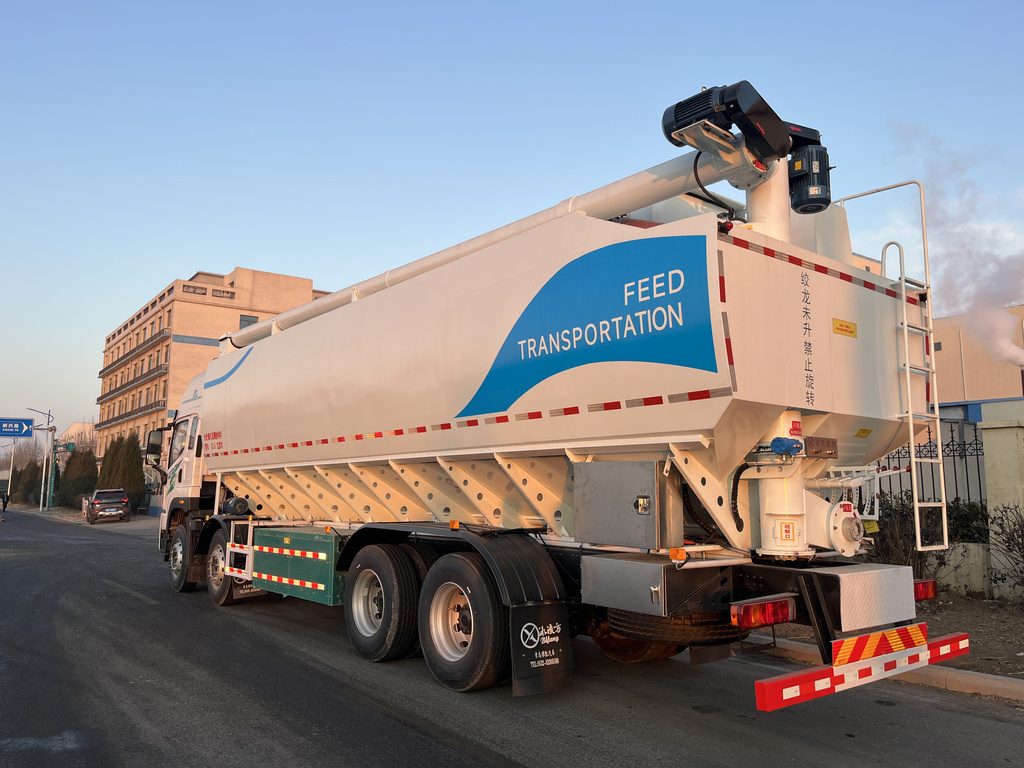
Bulk Feed Delivery Route Planning for Feed Mills and Distributors
Bulk Feed Delivery Route Planning for Feed Mills and Distributors
In short: Bulk feed route planning is the work of turning a list of orders into a sequence of stops that a truck can actually complete in a shift. It starts with each farm's access — gate width, yard surface, bin position and hose or auger reach — then groups stops by geography and ration type so that the truck empties in a sensible order and rarely returns to the mill with feed still on board.


What Is Bulk Feed Route Planning?
Bulk feed route planning is the process of assigning orders to trucks, deciding the order in which stopping points are visited, and matching the load — how many compartments, which formulas, how much of each — to the route ahead of it. It differs from parcel route planning in one important way: the product is heavy, perishable in quality terms, and delivered into fixed on-farm bins that the truck may or may not be able to reach.
That means route planning begins with a site survey rather than a map. A route that looks efficient on paper can fail at the first farm if the truck cannot turn in the yard or cannot reach the bin. Once access is known, the planning problem becomes one of sequencing and load building: fill the body in the reverse order of delivery, group stops that share formulas, and keep driving distance between stops as short as the road network allows.
Key Facts at a Glance
- Access survey — for each farm, record gate width, yard surface and slope, turning space, overhead obstructions such as wires or branches, and the distance from the parking point to each bin.
- Bin position and height — note whether the bin inlet is reachable by auger tube or needs pneumatic delivery, and how far the hose must run.
- Ration grouping — stops that take the same formulas can often share compartments; mixed orders need compartment isolation.
- Load sequence — the body is loaded so that the first farm delivered is the first compartment emptied, which reduces shuffling and cleaning between drops.
- Time per stop — plan on the basis of actual unloading time plus setup, because positioning and hose handling usually take longer than the flow itself.
- Return loads — backhauls, empty-bin checks and paperwork collection can be built into the same trip to raise the value of the kilometres driven.
Single-Stop Loads vs Multi-Drop Routes
- Load design — A single-stop load carries one destination and can be filled to suit that farm's bins; a multi-drop route is loaded in delivery order, with each compartment matched to a stop.
- Route planning effort — Single-stop loads are simple to schedule but can mean long distances for one customer; multi-drop routes need careful sequencing but spread transport cost across several farms.
- Time efficiency — A single stop concentrates unloading time at one place; a multi-drop route spends more time on positioning and setup between farms, so stop count has to stay realistic for the shift.
- Vehicle requirement — Single-stop loads often suit large bodies and long hauls; multi-drop work favours multi-compartment bodies and, in tight yards, shorter, more manoeuvrable units.
- Risk profile — A single-stop load only fails if that one site is inaccessible; a multi-drop route can be disrupted by one blocked yard, so a fallback order helps.
- Customer experience — Multi-drop routing gives more farms a scheduled slot; single-stop routing gives one customer a dedicated delivery window.
Step-by-Step: How to Build a Feed Delivery Route
1. Refresh the site survey. Walk or drive each farm at least once and record access, bin positions and any seasonal changes such as wet ground or harvest equipment.
2. Group orders by area and formula. Cluster stops geographically, then flag which ones share rations so compartments can be used efficiently.
3. Build the load backwards from delivery order. Fill the compartment that will be emptied first, and check that divider layout supports the sequence.
4. Set realistic time per stop. Use historical unloading times plus a margin for setup, and confirm the resulting stop count fits the legal driving hours and shift length.
5. Check axle and payload limits. Confirm the planned load for the route sits within legal payload and axle ratings before the truck leaves the mill.
6. Confirm with customers and dispatch. Share the planned window with each farm, note contact names and gate codes, and give drivers a clear fallback order if a site is inaccessible.
FAQ
Q: How many stops can one bulk feed truck serve in a day?
A: It depends on distance, unloading method and how long each farm takes to reach and set up. The reliable way to answer it is to time a few real runs, then build the schedule from observed cycle times rather than estimates.
Q: What farm information matters most for route planning?
A: Access and bin position. Gate width, yard surface, turning space and the distance from the truck to the bin decide whether a delivery takes twenty minutes or an hour.
Q: Should I plan routes around trucks or around customers?
A: Both, but customer demand sets the constraint. Build the route so that promised delivery windows are met, then choose the truck and body configuration that makes the sequence work.
Q: How do I handle a farm whose yard is too tight for the truck?
A: Options include delivering by pneumatic system from the road, using a smaller body on that route, consolidating the delivery with a neighbouring stop, or arranging for the customer to move feed from a nearer drop point.
Q: How does route planning affect feed quality?
A: Short, well-sequenced routes mean less time in transit and less handling, so feed arrives fresher and with less attrition. Long dwell times in a warm body also raise the risk of flow problems at the bin.
Conclusion
Feed route planning is a survey problem before it is a scheduling problem. Know each farm's access and each bin's reach, sequence the load to match the delivery order, and set stop counts from real cycle times rather than optimism. Do that and the same fleet moves more feed with fewer surprises. Binglingfang builds bulk feed bodies in several compartment and discharge configurations, so it helps to bring your surveyed route list to the specification discussion.
Sanitation SOP for Refrigerated Food Transport: A Step-by-Step Cleaning Routine
Sep 23, 2026
Bulk Feed Truck Body Materials: Steel, Aluminum and Stainless Compared
Sep 24, 2026
Related Articles

Author

Cybercoldchain
Content Writer
Recent Posts
-
GMP+ and FAMI-QS: Is Transport the Weak Link in Feed Safety?
Oct 31
-
Driver Shortages vs Delivery Windows: What Gives First?
Oct 31
-
Telematics for Bulk Feed: Is Bin-Level Data Worth the Investment?
Oct 31
-
Can Reefers Keep Up With 45°C+ Markets—or Do Specifications Need a Rethink?
Oct 31
-
The Hidden Cost of a Late Chick Delivery—Who Should Bear It?
Oct 31