
Seasonal Capacity: Should Hatcheries Own Trucks or Contract Them?
In short: Own the base load and contract the peaks — but only if the base load is genuinely stable and the contractor can meet your temperature and ventilation standard. Most hatcheries get this wrong in one direction or the other: they buy capacity for their busiest month and carry it through the quiet ones, or they outsource everything and discover in peak season that their quality left with the truck.


What Is Seasonal Capacity in Chick Transport?
Seasonal capacity is the gap between the transport a hatchery needs in its busiest weeks and the transport it needs in its quietest. Because hatching is planned weeks ahead but demand moves with weather, holidays and customer placement cycles, that gap can be wide and predictable in shape, if not in exact size.
The fleet decision is how to cover it: buy vehicles, hire contract carriers, or mix the two. Each option converts a different kind of risk into a different kind of cost.
Why This Debate Matters
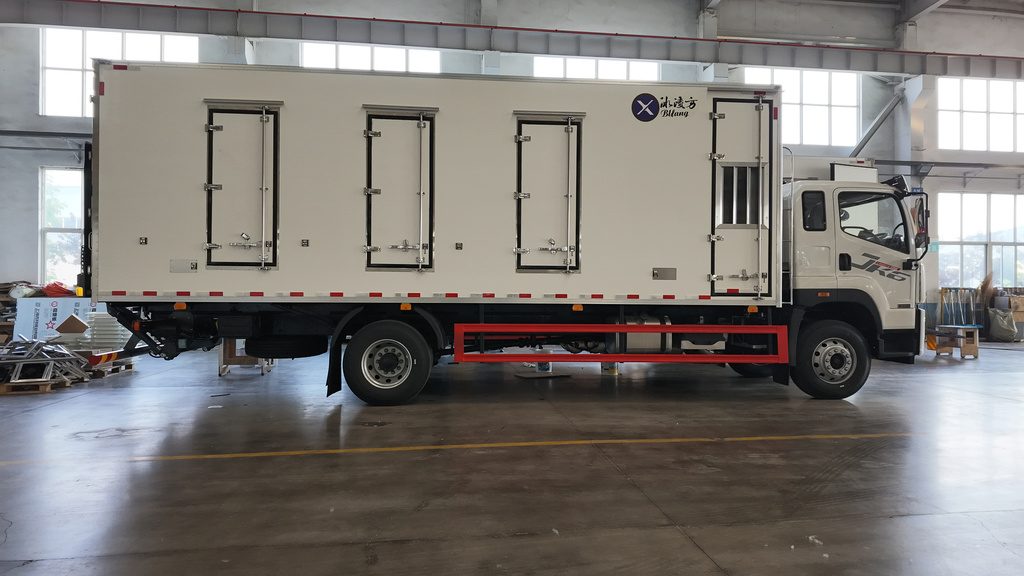
A chick truck is a specific asset. It is not a general-purpose lorry that can be redeployed when demand dips, because its value comes from ventilation, temperature control and a body designed around boxes and carts. Idle in January, it still depreciates, still needs servicing and still occupies a driver.
Contract capacity has the opposite profile. It costs nothing when unused, and it costs a premium exactly when everyone else wants it too — which is peak season, when every hatchery in the region is competing for the same vehicles.
There is a quality dimension that rarely appears in the spreadsheet. A contract driver who carries for three hatcheries may not know your loading pattern, your ventilation settings, or your rule about leaving the doors open. A load can be perfectly legal and still arrive in worse condition than one carried by a driver who has done the route fifty times.
Key Facts at a Glance
- Chick transport capacity is body-dependent: 232 boxes at 4.2 m, 464 at 6.8 m, 536 at 7.8 m, 672 at 9.6 m on ventilated units; a 9.6 m constant-temperature unit carries 624 boxes as 24 carts of 26.
- Cargo temperature is held at 22–26 °C and CO₂ must stay at or below 3000 ppm, with 2800 ppm as an operating target — standards a contract carrier must be able to demonstrate, not just accept.
- Ventilated units use fans and ventilation windows with an optional auxiliary cooling unit of limited effect; constant-temperature units add active cooling, heating and controlled air exchange with an independent engine.
- A constant-temperature unit's backup is a chassis generator that drives fans only, plus a battery giving roughly two hours — so an unattended parked vehicle is not a safe holding solution.
- Equipment is specified for −35 °C to +40 °C ambient, which means summer peak and winter peak stress different systems, not the same one.
- Cart-based loading on a 9.6 m constant-temperature unit shortens turnaround at each stop, which matters when a contract driver is paid by the trip.
Two Sides: A vs B
- Capital versus variable cost — Own view: a fixed asset spreads cost across many loads and removes the peak premium. Contract view: no depreciation, no idle months, no driver on payroll in the quiet season.
- Control over quality — Own view: your driver, your settings, your standard, every load. Contract view: standards can be written into a contract and audited, and a specialist carrier may run better procedures than a hatchery that transports occasionally.
- Peak availability — Own view: capacity is there when you need it, which is the whole point. Contract view: contracts with priority clauses and advance booking cover most peaks, at a price.
- Utilisation — Own view: utilisation can be improved by backhauling or by serving neighbouring hatcheries. Contract view: the carrier carries the utilisation risk, which is precisely what you are paying for.
- Failure modes — Own view: a breakdown is your breakdown, and the load waits. Contract view: a contractor's breakdown is also your breakdown unless a replacement clause exists.
Step-by-Step: How to Decide Your Mix
- Plot twelve months of loads, not last year's peak. Use boxes per week, not trips, so vehicle size decisions are grounded in volume.
- Find your base load. The volume you can fill in your quietest month is the capacity that ownership can justify. Everything above it is a candidate for contract.
- Cost the idle months honestly. Include depreciation, insurance, driver retention and the servicing that a parked vehicle still needs. Compare that with peak-season contract premiums.
- Write the standard into the contract. Temperature band, CO₂ ceiling, loading method, door discipline and reporting should be specified, with the right to audit.
- Qualify a second carrier before you need one. Peak capacity is found in the off-season, not during it.
- Review the mix annually. Seasonal shape changes with customer mix and with the placement calendars of your largest farms.
FAQ
Q: Is owning always cheaper at high volume?
A: At genuinely high and stable volume, often yes. If volume is high for eight weeks and low for the rest, ownership can still lose to a mixed model.
Q: Can a contract carrier meet the same temperature standard?
A: Only if the requirement is written down and verifiable. Ask for journey logs showing 22–26 °C and CO₂ below the ceiling, and check whether the equipment is ventilated or actively cooled.
Q: What is the biggest hidden cost of owning?
A: Underutilisation in the quiet season, combined with driver retention. A vehicle with no work still needs a qualified driver to be available when work returns.
Q: Should hatcheries share a fleet?
A: It can work where several hatcheries serve overlapping routes and can agree scheduling. The difficulty is priority during peak, which is exactly when cooperation is hardest.
The Bottom Line
The right answer is usually a mixed fleet sized to the base load, with contract capacity for the peak and a written standard that applies to both. Ownership buys control over the variables that determine chick quality; contracting buys the ability to not pay for them in the quiet weeks. The mistake is choosing one model for ideological reasons rather than for a utilisation curve. So, for those who have run both: what did the contract trucks cost you that the invoice did not show?
Who Really Pays for Reefer Fuel? Idle Time, Door Openings and Cost per Pallet
Oct 27, 2026
Monsoon Logistics: Are Feed Fleets Underestimating Humidity Damage?
Oct 28, 2026
Related Articles
Author

Cybercoldchain
Content Writer
Recent Posts
-
GMP+ and FAMI-QS: Is Transport the Weak Link in Feed Safety?
Oct 31
-
Driver Shortages vs Delivery Windows: What Gives First?
Oct 31
-
Telematics for Bulk Feed: Is Bin-Level Data Worth the Investment?
Oct 31
-
Can Reefers Keep Up With 45°C+ Markets—or Do Specifications Need a Rethink?
Oct 31
-
The Hidden Cost of a Late Chick Delivery—Who Should Bear It?
Oct 31