
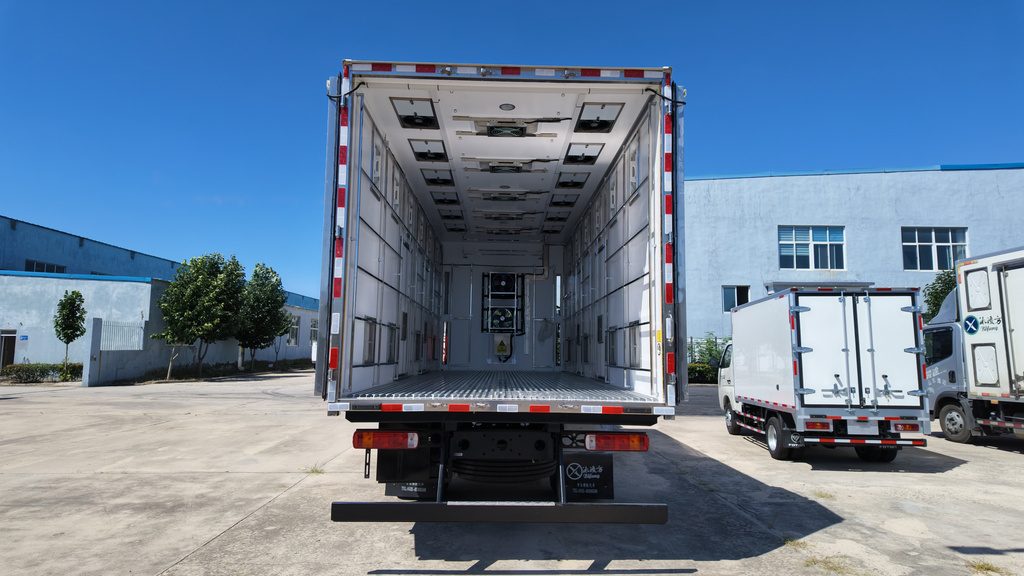
Chick Transport Emergency Plan: If the AC or Ventilation Fan Fails
In short: If cooling or ventilation fails in a chick truck, the priority is to restore air movement first, then cooling, then reach a safe point. On a constant-temperature chick truck the backup is a chassis generator that supplies the fans only, plus a battery that runs the fans for roughly two hours — it does not drive the air conditioning. On a ventilated chick truck, power comes from an independent diesel generator with an optional 220 V supply. Every plan should be written and rehearsed before it is needed.


What Is a Chick Transport Emergency Plan?
A chick transport emergency plan is a written set of actions for the failure modes that occur on the road: a cooling system shutting down, a fan stopping, a generator failing to start, a power supply tripping, or a truck becoming immobilised with a live load. It exists because these failures happen mid-route, with a driver who has less than a minute to decide.
The plan answers three questions in advance: what can fail, what backup exists, and where do you go. The failure that matters most is loss of airflow, because without air movement heat and CO₂ build up together.
Key Facts at a Glance
- A constant-temperature chick truck has eight systems — refrigeration, heating, environmental control, humidification, loading and unloading, filtration, monitoring and emergency power.
- Its backup power is a separately fitted chassis generator that supplies the fans only, providing natural airflow to prevent the load from suffocating.
- A battery set in the same truck can run the fans for approximately two hours, giving the driver a defined window to reach a safe point.
- A ventilated chick truck is equipped differently: it uses an independent diesel generator, with an optional 220 V supply, to power its fans.
- Constant-temperature trucks control 22–26 °C and CO₂ at no more than 3,000 ppm, and are rated for outside conditions from −35 °C to +40 °C.
- Systems on a constant-temperature chick truck are installed inside the cargo box, so a failure is diagnosed from inside rather than from an external unit.
Chassis Generator Backup vs Independent Diesel Generator
- What it powers — The constant-temperature truck's chassis generator drives the fans only; the ventilated truck's independent diesel generator supplies its ventilation system.
- Cooling on backup — Neither backup drives active cooling on its own; the fans prevent suffocation and slow heat build-up rather than holding the 22–26 °C band.
- Duration — The battery set gives roughly two hours of fan operation on a constant-temperature truck; the diesel generator on a ventilated truck runs as long as it has fuel.
- Driver action — A constant-temperature truck failure means switch to fan backup and drive on; a ventilated truck failure means start the generator and keep the ventilation path open.
- What it is for — The backup exists to buy time to reach a safe point, not to complete the original delivery schedule.
Step-by-Step: What to Do When Cooling or Ventilation Fails
1) Identify what has actually failed. Determine whether the problem is the cooling system, a fan, the power supply or the control system. The distinction matters: a fan failure is an airflow emergency, while a cooling-only failure leaves airflow and a rising temperature.
2) Restore airflow immediately. Bring in whatever ventilation you have — open the ventilation windows, set the front intakes and the rear louvred door for through-flow, and start the backup fans. On a constant-temperature truck, switch to the chassis generator feeding the fans and confirm battery backup for roughly two hours.
3) Reduce the heat load on the box while you drive. Increase vehicle speed where safe and legal to improve natural airflow and avoid stopping; if you must stop, get the truck into shade. Opening the rear louvred section while moving creates through-flow along the load.
4) Call base and state the position. Report the failure, the readings, the outside temperature and your time to the nearest safe point. Base can decide whether to send a second truck, redirect to a closer drop-off, or prepare a receiving point.
5) Drive to a safe point, not the original destination. The plan should name fallback locations along each regular route in advance — a partner farm, a depot, a shaded staging area with power. A known fallback beats an improvised one.
6) Hand over, record and inspect. On arrival, unload and check the load, then record the failure, readings, duration and actions taken. Investigate the root cause before the truck returns to service — the same failure on a hotter day is more serious.
FAQ
Q: Does the backup generator keep the air conditioning running?
A: No. On a constant-temperature chick truck the backup is a chassis generator that supplies the fans only, keeping air moving so the load does not suffocate. Active cooling is not part of the backup.
Q: How long do I have if the fans stop completely?
A: Treat a total airflow loss as urgent and act immediately. The battery set gives roughly two hours of fan operation, but that is a window to reach a safe point — not a budget to continue the original run.
Q: How is a ventilated truck different in an emergency?
A: A ventilated truck carries an independent diesel generator, with an optional 220 V supply, to power its fans. With no active cooling in normal operation, emergency management focuses on restoring fan power and keeping windows, intakes and the rear louvred door open for through-flow.
Q: What is the single most useful preparation?
A: Naming the fallback points along your regular routes in advance. Drivers who know where the nearest shaded staging area, partner farm or depot is with power available will decide faster than drivers working it out by the roadside.
Q: Can I fit monitoring to catch this earlier?
A: Yes. Monitoring options let the driver see changes inside the box. A rising CO₂ trend with steady temperature often indicates failing air exchange.
Conclusion
A chick truck emergency plan rests on three facts: airflow comes first, backup power buys time rather than finishing the job, and the plan must name where to go. Know which backup your truck carries, switch to fans immediately, keep through-flow open, and drive to a prepared fallback point. Binglingfang builds constant-temperature chick trucks with an emergency power system and ventilated trucks with diesel generator options; our team can help you document a plan for your setup.
How to Read a Refrigerated Truck Body Spec Sheet: Insulation Explained
Sep 27, 2026
Refrigerated Truck Door Configurations: Rear, Side and Multi-Temperature Access
Sep 29, 2026
Related Articles
Author

Cybercoldchain
Content Writer
Recent Posts
-
GMP+ and FAMI-QS: Is Transport the Weak Link in Feed Safety?
Oct 31
-
Driver Shortages vs Delivery Windows: What Gives First?
Oct 31
-
Telematics for Bulk Feed: Is Bin-Level Data Worth the Investment?
Oct 31
-
Can Reefers Keep Up With 45°C+ Markets—or Do Specifications Need a Rethink?
Oct 31
-
The Hidden Cost of a Late Chick Delivery—Who Should Bear It?
Oct 31