
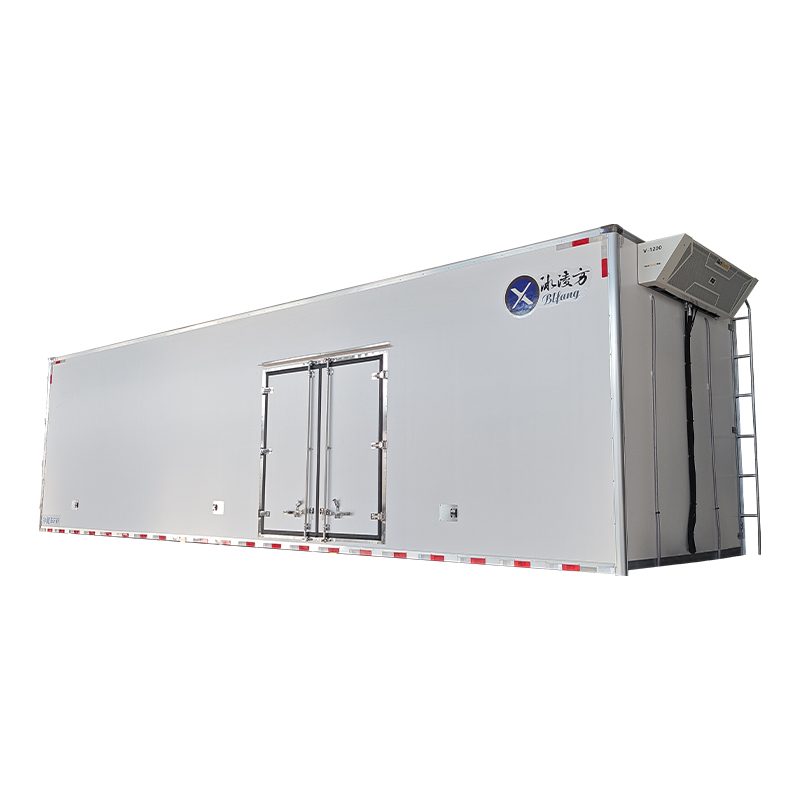
How to Read a Refrigerated Truck Body Spec Sheet: Insulation Explained
In short: A refrigerated truck body spec sheet matters most for three things: the insulation core, the panel thickness, and the way the panels are bonded and sealed. Read those three carefully and you can compare quotations from different builders on equal terms. Everything else on the sheet is supporting detail.


What Is a Refrigerated Truck Body Spec Sheet?
A refrigerated truck body spec sheet is the technical document that describes the insulated cargo box itself: its structure, materials, panel thickness, internal dimensions, weight and thermal properties. It is not the same as the chassis spec sheet, which describes the truck underneath — engine, wheelbase and payload rating. Buyers often receive both in one package, but they answer different questions.
The body sheet is what tells you how well the box will hold temperature, how much usable volume you actually get, and how much the box weighs before you load anything. Two suppliers can quote the same external dimensions and still deliver different internal volume and different weight, and that difference is usually where the money sits.
Key Facts at a Glance
- Polyurethane integral foam cores are commonly quoted with a closed-cell rate of 95 percent or higher and a thermal conductivity of about 0.022 W/(m·K). Treat these as manufacturer product parameters rather than a field average.
- Two bonding methods are widely used and both are mature production lines: FRP sandwich panels assembled by dry bonding, and polyurethane integral foam injected as a liquid between the skins.
- A 4.2 m refrigerated body can be built at roughly 670 kg. Every kilogram of body weight is a kilogram you cannot load.
- Chilled cargo is normally carried at 0 to 4 degrees Celsius, and frozen cargo at around minus 18 degrees Celsius. These are industry conventions for the food cold chain, not brand-specific claims.
- Thicker panels reduce the load on the cooling unit, but they also reduce internal volume for a given external box size.
- Sealing and drainage details — door gaskets, panel joints and floor channels — often decide whether a good core still performs well after two years of service.
A vs B: FRP Sandwich vs Polyurethane Integral Foam
- How it is made — FRP sandwich panels are produced by dry bonding pre-cut insulation boards between fiberglass-reinforced plastic skins; polyurethane integral foam is injected as a liquid between the skins and expands in place to fill the cavity.
- Repairability — In sandwich construction a damaged area can often be cut back and replaced as a section; integral foam is one continuous core, so a repair usually covers a larger area.
- Custom geometry — Sandwich panels suit non-standard door openings, cutouts and smaller batches; integral foam suits repeatable box dimensions where the tooling already exists.
- Weight and volume — Both can be built light. The real figure depends on panel thickness, core density and frame design, so ask for the number in kilograms rather than the word "lightweight."
- Typical use — Both are used for chilled and frozen distribution, meat hook bodies and pharmaceutical boxes. The choice is usually decided by repair expectations, order size and body geometry.
Step-by-Step: How to Read an Insulation Spec Sheet
1) Identify the core material first. Look for polyurethane foam, XPS, or sandwich panel, and note whether the sheet describes an injected core or a bonded board core.
2) Read the panel thickness for walls, floor, roof and doors separately. A single "80 mm" figure that hides four different values is worth questioning.
3) Check the thermal values. If a conductivity figure is quoted, note the unit, W/(m·K), and check whether it is described as a product parameter or a tested average.
4) Look at bonding and framing. Does the sheet explain how skins are joined to the core, and whether a metal or timber frame is used? This affects both repair and weight.
5) Check sealing and drainage. Door gaskets, panel joint treatment and floor drainage channels are the parts that show wear first.
6) Ask for total body weight and internal dimensions in writing. Weigh these against your payload and route before signing.
FAQ
Q: What insulation thickness should I choose?
A: It depends on the temperature band, the box size and how often the doors open. Frozen cargo and long routes generally justify thicker panels than short chilled runs. Ask the builder to show how thickness interacts with the cooling unit size rather than picking a number in isolation.
Q: Is thermal conductivity a reliable way to compare two bodies?
A: It is useful when both figures are measured the same way and quoted in the same units. A conductivity figure describes the core material only. It does not describe panel joints, door gaskets or the quality of the bond, which matter just as much in service.
Q: Does a heavier body mean better insulation?
A: Not automatically. Weight comes from core density, panel thickness, frames and hardware. A well-designed body can be light and still hold temperature well, which is why the sheet should give you a kilogram figure rather than a vague claim.
Q: Can I mix panel thicknesses on one body?
A: Yes, and many practical builds do exactly that: a thicker roof and floor, standard walls, reinforced door panels. What matters is that the spec sheet states each value separately so you know what you are buying.
Q: Why does the sheet mention the floor drainage channel?
A: Wash water and condensation have to leave the box. A defined floor channel keeps standing water away from cargo and makes routine cleaning faster, which matters for food transport inspections.
Conclusion
Reading a refrigerated body spec sheet is mostly about knowing where to look: core material, panel thickness, bonding method, sealing and weight in kilograms. Once those five items are in writing, quotations from different builders become comparable, and the conversation moves from adjectives to numbers. If you are specifying a body now, ask for the internal dimensions, the per-panel thickness and the total body weight first — those three numbers will guide everything else.
How Feed Moisture and Particle Size Affect Discharge Performance
Sep 26, 2026
Chick Transport Emergency Plan: If the AC or Ventilation Fan Fails
Sep 29, 2026
Related Articles

Author

Cybercoldchain
Content Writer
Recent Posts
-
GMP+ and FAMI-QS: Is Transport the Weak Link in Feed Safety?
Oct 31
-
Driver Shortages vs Delivery Windows: What Gives First?
Oct 31
-
Telematics for Bulk Feed: Is Bin-Level Data Worth the Investment?
Oct 31
-
Can Reefers Keep Up With 45°C+ Markets—or Do Specifications Need a Rethink?
Oct 31
-
The Hidden Cost of a Late Chick Delivery—Who Should Bear It?
Oct 31