
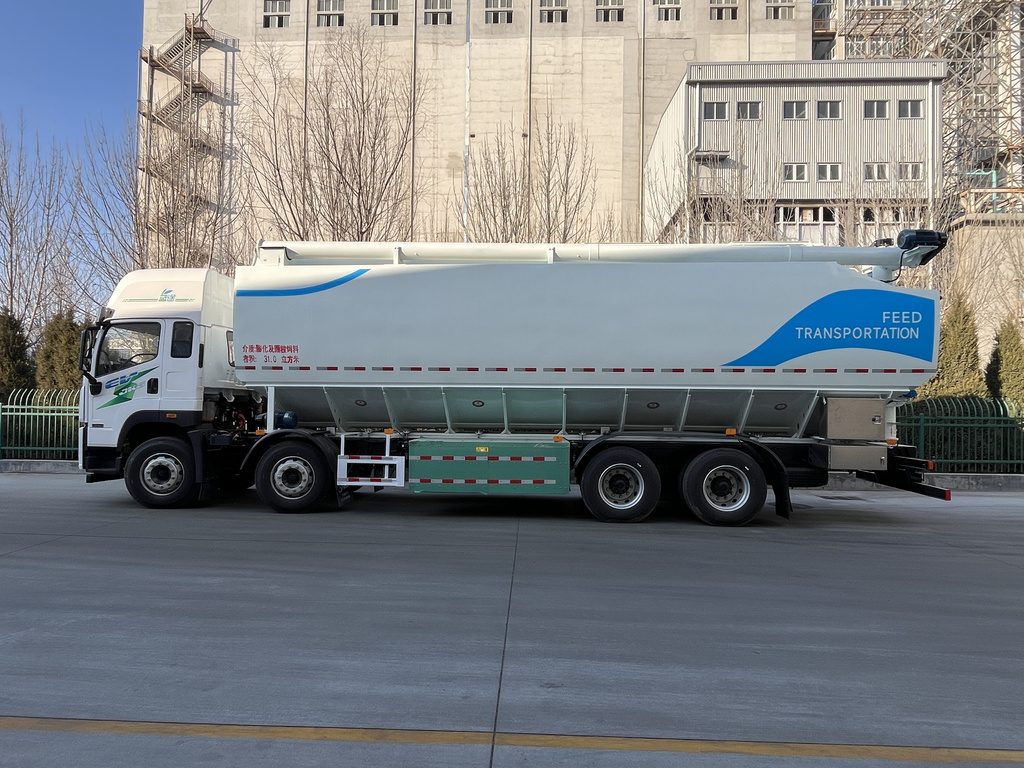
How Feed Moisture and Particle Size Affect Discharge Performance
How Feed Moisture and Particle Size Affect Discharge Performance
In short: Feed moisture and particle size are the two biggest influences on how well a bulk load unloads. Damp feed sticks to walls and to itself, fines pack and bridge, and uniform well-formed pellets flow most predictably. The practical levers are moisture control at intake, limiting fines and broken pellets, and keeping the body clean, smooth and free of residues that give sticky material a place to start.


What Is Discharge Performance?
Discharge performance is how reliably, evenly and completely feed leaves the body when the operator calls for flow. It is a combination of flow rate, flow consistency, and the amount of material left behind after the system is run empty.
Discharge performance is a property of the feed and the body together, not of either alone. The same truck that empties a clean, dry pellet load quickly can stall on a damp load of fines. That is why experienced operators talk about feed characteristics when diagnosing flow problems, rather than blaming the machine. Feed is a granular material, and granular materials flow according to their bulk properties: particle size and shape, size distribution, moisture content, density, and how long the material has been sitting under load.
Key Facts at a Glance
- Moisture raises cohesion — water films between particles create capillary forces that make feed stick to walls and to itself, so even a modest rise in moisture changes flow behaviour noticeably.
- Fines are the packing fraction — small particles fill the gaps between larger ones, increasing bulk friction and making the mass much harder to move.
- Uniform pellets flow most predictably — well-formed, screened pellets with few broken pieces move from hopper to outlet with the least resistance.
- Time under load compacts feed — vibration during travel and hours of standing settle the material and raise pressure at the outlet.
- Temperature and humidity interact — warm, humid air in a body that has been sitting in the sun softens pellets and increases stickiness on interior surfaces.
- Surface condition multiplies the effect — residue from a previous load gives sticky material a starting point, so a clean interior makes marginal feed behave better.
Coarse, Uniform Feed vs Fine, Damp Feed
- Flow behaviour — Coarse uniform feed moves freely and drains evenly; fine damp feed tends to hang on walls and bridge at the outlet.
- Bridging tendency — Uniform pellets rarely bridge unless the outlet is very narrow; fines and damp material bridge even at generous outlet sizes.
- Residue left behind — Uniform pellets leave little behind after a proper empty-out; fines cling to surfaces and require brushing.
- Dust generation — Uniform pellets generate little dust during handling; fine material produces dust at loading and at the bin.
- Effect on discharge equipment — Clean pellets are gentle on auger flights and air lines; fine abrasive material causes more wear on moving parts over time.
- Handling adjustments — Uniform feed tolerates faster discharge; fine or damp feed is better handled at a steadier rate with more attention to complete empty-out.
Step-by-Step: How to Keep Discharge Consistent
1. Check moisture at intake. Sample or meter the feed when it is loaded, and note anything that feels damp or clumped before it goes into the body.
2. Reduce fines at loading. Load at a controlled rate and avoid long drops that shatter pellets, and screen out excessive dust where the mill layout allows.
3. Fill evenly across the body. Spread feed rather than dumping it in one place, so pressure at the outlet stays even and compaction is reduced.
4. Keep the interior clean and smooth. Empty each compartment completely, remove residue, and inspect for damaged liners or rough patches that grab sticky feed.
5. Match discharge rate to the feed. Run the system at a steady rate rather than flat out, especially with fine or damp material, and watch the bin rather than the controls.
6. Note what happens for next time. Record feed type, moisture condition and any flow problem, so the loading plan can be adjusted for that product in future.
FAQ
Q: Why does feed that flowed at the mill stall at the farm?
A: Because it settled. Vibration during the journey compacts the load and raises pressure at the outlet, and if the feed is damp or fine it can bridge. Feed that stood in a warm body for hours also firms up.
Q: Does particle size matter as much as moisture?
A: Both matter and they interact. Moisture raises cohesion between particles, while particle size distribution decides how tightly the mass packs. A dry load of fines flows better than a damp load of fines, but a uniform pellet flows most predictably of all.
Q: Can I dry feed in the truck?
A: No, the body is not a dryer. Moisture has to be managed at intake and during storage at the mill. Once damp feed is loaded, the practical options are to unload promptly and clean thoroughly afterwards.
Q: How do I know if the problem is the feed or the body?
A: Compare loads. If the same feed flows well from one body and poorly from another, look at hopper geometry, residue and outlet condition. If the same body handles most feeds well but struggles with one product, the feed is the more likely cause.
Q: Does discharge rate affect feed quality?
A: It can. Fast, aggressive flow through an auger or air line increases mechanical contact and can break pellets further, which adds fines to the load and to the next one if the body is not cleaned.
Conclusion
Moisture and particle size set the limit on how well a bulk feed load will unload, and no amount of throttle will fix a damp, fine product. Manage moisture at intake, keep fines down, load evenly, empty the body completely, and match the discharge rate to the feed in front of you. Binglingfang builds bulk feed bodies with the hopper geometry, outlet sizing and clean-out access that help operators handle varied feed types, and it is worth describing your typical product mix when specifying a body.
Preventing Bridging and Blockages in Bulk Feed Hoppers
Sep 25, 2026
How to Read a Refrigerated Truck Body Spec Sheet: Insulation Explained
Sep 27, 2026
Related Articles
Author

Cybercoldchain
Content Writer
Recent Posts
-
GMP+ and FAMI-QS: Is Transport the Weak Link in Feed Safety?
Oct 31
-
Driver Shortages vs Delivery Windows: What Gives First?
Oct 31
-
Telematics for Bulk Feed: Is Bin-Level Data Worth the Investment?
Oct 31
-
Can Reefers Keep Up With 45°C+ Markets—or Do Specifications Need a Rethink?
Oct 31
-
The Hidden Cost of a Late Chick Delivery—Who Should Bear It?
Oct 31