
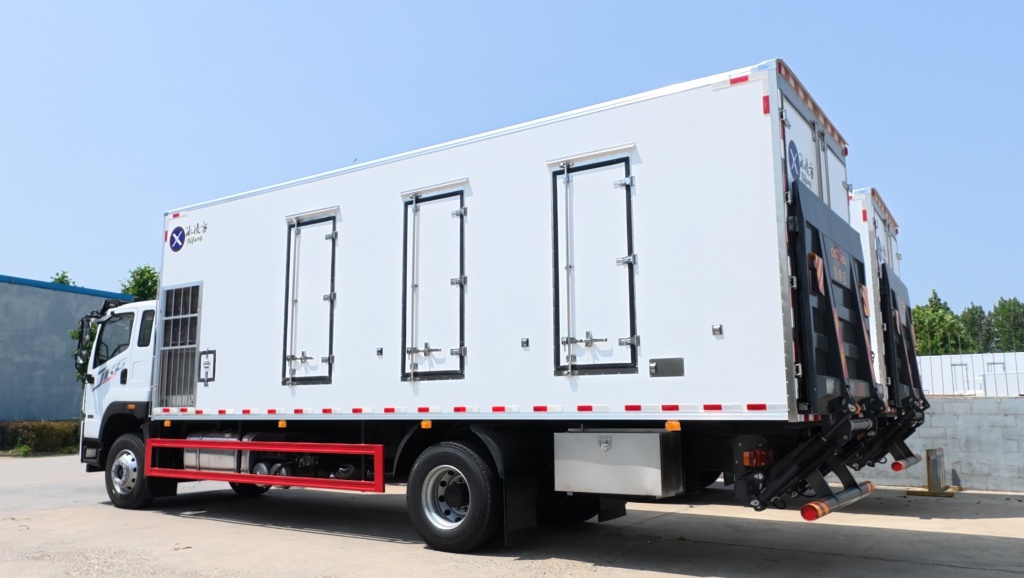
Climate-Controlled vs Standard Chick Transport Truck – Complete Guide
Climate-controlled vs ventilated chick transport truck. Here's a clear breakdown to help you decide.
**Who should choose a ventilated chick truck?**
A standard ventilated chick truck relies on natural and forced ventilation to exchange air and remove heat. The front panel has air inlets, the roof has ventilation windows and exhaust fans, and the floor has T-shaped ventilation channels. As the truck moves, the airflow creates negative pressure that pushes hot air out.
Best for:
- Short-distance transport (within 300 km)
- Regions with mild climates
- Budget-conscious operations starting out
You can also add optional heating (floor heating, diesel heater) or an air conditioner to improve temperature control.
**Who should choose a climate-controlled chick truck?**
The Binglingfang climate-controlled chick truck features 8 integrated systems: refrigeration, heating, environment control, humidification, loading/unloading, air filtration, monitoring, and emergency backup. Cabin temperature stays stable between 22°C and 26°C (72-79°F). CO₂ levels trigger automatic air exchange when they exceed 3,000 PPM.
Best for:
- Long-distance transport, 500+ km
- Routes crossing regions with large temperature swings
- High-value chick breeds requiring higher survival rates
- Year-round operation in both summer and winter
**How to decide?**
Two key factors: transport radius and chick value.
If you mainly run short distances (under 300 km) in stable climates, a ventilated model will serve you well at a lower upfront cost. For long hauls, cross-region routes, or high-value chicks, the climate-controlled model pays off — lower losses per trip can offset the higher purchase price within a reasonable timeframe.
Climate-controlled trucks also simplify daily operations. The driver sets the target temperature and the system handles ventilation, cooling, and heating automatically. Less manual adjustment means fewer errors.
If your routes and budget are still evolving, the ventilated model with optional heating or AC is a solid intermediate choice. You get partial temperature control without the full investment of a climate-controlled system.
Why Chick Trucks Use FRP Insulated Bodies — Same as Reefer Trailers
May 28, 2026
Essential Features of a Day-Old Chick Transport Truck
Jun 2, 2026
Related Articles
Author

Cybercoldchain
Content Writer
Recent Posts
-
GMP+ and FAMI-QS: Is Transport the Weak Link in Feed Safety?
Oct 31
-
Driver Shortages vs Delivery Windows: What Gives First?
Oct 31
-
Telematics for Bulk Feed: Is Bin-Level Data Worth the Investment?
Oct 31
-
Can Reefers Keep Up With 45°C+ Markets—or Do Specifications Need a Rethink?
Oct 31
-
The Hidden Cost of a Late Chick Delivery—Who Should Bear It?
Oct 31