
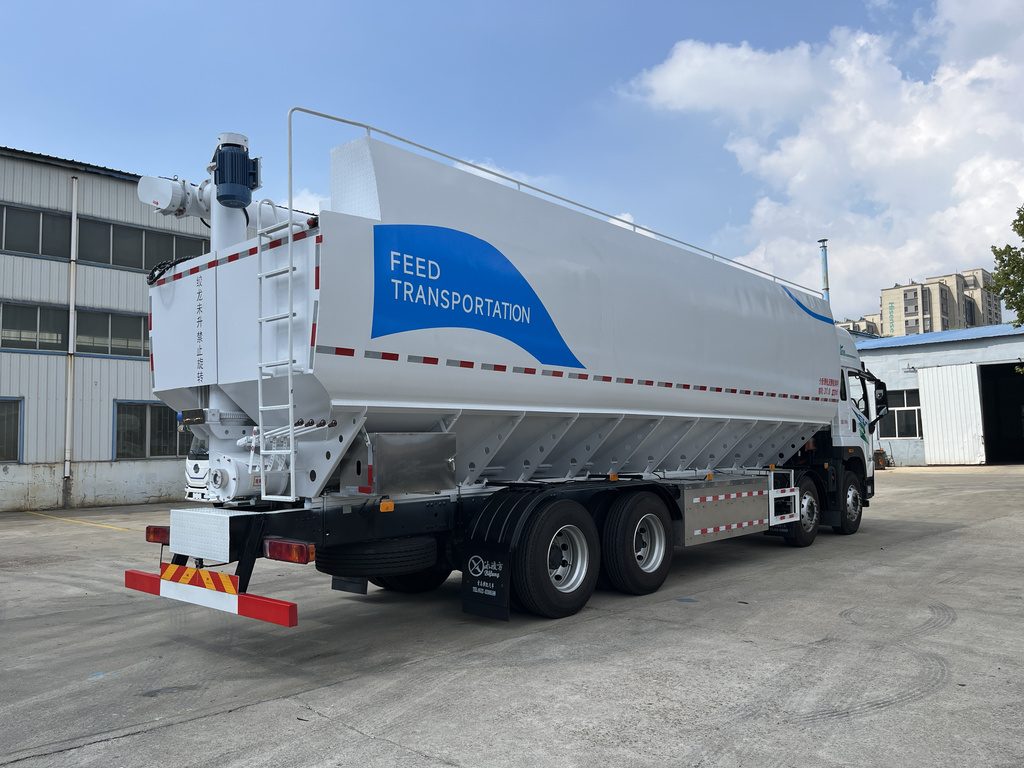
Feed Mill Logistics in 2026: Are Bulk Fleets Finally Getting Smarter?
In short: Partly, and unevenly. Feed mills have digitised formulation and production far faster than they have digitised the loading bay and the farm gate, so the weakest link in many supply chains is still the last few kilometres. Fleets that genuinely got smarter did it through disciplined scheduling and honest data capture, not through one clever platform.


What Is Feed Mill Logistics?
Feed mill logistics is the movement of finished feed from the mill's load-out bins to the bin on the farm, and everything that has to line up: order batching, truck allocation, route sequencing, compartment assignment, discharge at the farm, and the records that prove what went where. It is distinct from feed production, though tightly coupled: a mill that batches without looking at truck capacity simply moves the bottleneck a few metres downstream. In practice, it is a scheduling problem wearing a truck's clothing.
Why This Debate Matters
Feed is a low-margin, high-volume product, and moving it is a large share of what the customer pays. Mills have spent years tightening formulation costs and plant efficiency, and the remaining gains are increasingly found in the yard: how quickly a truck is loaded, how many stops it can serve before a driver's hours run out, and how often a farm bin is either empty or overfilled. Meanwhile, farms have consolidated into larger units with stricter biosecurity and narrower receiving windows, pushing complexity onto the fleet. Add driver availability pressure and rising equipment costs, and the question stops being philosophical: every hour a bulk truck spends waiting is an hour that has to be paid for somewhere.
Key Facts at a Glance
- A bulk feed trailer is normally divided into several compartments, so one vehicle can carry different formulations or different customers on a single run.
- Discharge is typically by onboard auger, by pneumatic blowing, or by gravity, and the choice constrains both the trailer design and the farm's receiving equipment.
- Compartment layout determines how much feed remains as residue after discharge, which is a food-safety issue as much as a commercial one.
- Farm bins are the real endpoint; a delivery is not complete until the feed is in the bin, not merely out of the trailer.
- Axle load and gross vehicle weight rules cap how much feed a given chassis can legally carry, so "bigger trailer" is not automatically "more payload".
- Cleaning between loads is a scheduled task, not an optional one, whenever species or medication changes are involved.
Two Sides: A vs B
- Where the gain sits — One camp argues the money is in software — order visibility, dynamic routing and shared mill-farm data; the other argues it is in physical throughput at the loading bay and farm gate, where no dashboard helps if the auger is too short.
- Value of bin-level data — Optimists treat farm bin readings as the foundation of everything, allowing deliveries to be triggered by actual consumption; sceptics point out that a sensor tells you what is in the bin, not when the farm can receive a truck, and the two are frequently different problems.
- Scheduling philosophy — Fixed weekly routes are defended as predictable and cheap to plan; dynamic scheduling is defended as responsive to real demand, though it demands accurate data and disciplined customers.
- Driver role — Some fleets see the driver as a sensor and a decision-maker, feeding back bin conditions and access problems; others treat the driver as pure execution and try to remove discretion entirely.
- Equipment investment — One view says smarter logistics needs newer trailers with better discharge control; the other says a well-maintained older fleet with a tight process beats new iron with a loose one.
- Measurement — Progress is claimed through dashboards; the counter-argument is that many fleets still cannot state their true on-time rate or residual loss with confidence, which makes dashboards decorative.
Step-by-Step: How to Make a Bulk Feed Route Genuinely Smarter
- Measure the current baseline honestly. Record loading, travel, farm waiting, discharge and residue per load for four to six weeks before changing anything.
- Separate the constraints. Identify whether the bottleneck is mill load-out, truck capacity, farm windows or driver hours; each has a different fix.
- Map compartments to customers. Assign compartments deliberately so that cleaning and changeover effort is minimised across a typical day's mix of formulations.
- Fix the receiving end first. Confirm bin capacity, inlet height, hose reach and access before optimising the route; a perfect schedule fails at a bin that cannot be reached.
- Introduce data capture where it is cheap. Start with timestamps and load records, then add bin sensing only where the measurement changes a decision.
- Review weekly, not annually. Route performance drifts with harvest cycles, weather and customer behaviour, so the review cadence has to match the drift.
FAQ
Q: Does smarter feed mill logistics require new trucks?
A: Not necessarily. Scheduling discipline, accurate load records and better compartment planning often deliver more than new equipment, though an ageing trailer with poor discharge control can cap what any process improvement achieves.
Q: How many compartments should a bulk feed truck have?
A: It depends on the customer mix. More compartments mean more formulations per run but less capacity per compartment and more cleaning between uses, so the right number follows the delivery pattern rather than a general rule.
Q: Is bin-level monitoring essential?
A: It is valuable where farms are large, consumption is stable and the cost of an empty bin is high. On smaller or highly variable sites, the same money may be better spent on reliable receiving equipment.
Q: Where do most delays actually occur?
A: Usually at the two ends: waiting to load at the mill, and waiting to discharge at the farm. Road time is the part fleets already measure.
The Bottom Line
Bulk feed logistics in 2026 is smarter at the top of the chain and largely unchanged at the bottom, and the gap is where the cost sits. The fleets that improve fastest tend to be the ones that measured their own operation before buying anything, then fixed the physical constraint before the digital one. Technology helps, but it amplifies whatever process it lands on — good or bad. If your fleet had to publish one honest number about its delivery performance next quarter, which number would you choose, and could you actually defend it?
Is the Cold Chain Really Broken at the Loading Dock?
Oct 24, 2026
Hatchery Windows vs Truck Schedules: Who Should Adapt to Whom?
Oct 24, 2026
Related Articles

Author

Cybercoldchain
Content Writer
Recent Posts
-
GMP+ and FAMI-QS: Is Transport the Weak Link in Feed Safety?
Oct 31
-
Driver Shortages vs Delivery Windows: What Gives First?
Oct 31
-
Telematics for Bulk Feed: Is Bin-Level Data Worth the Investment?
Oct 31
-
Can Reefers Keep Up With 45°C+ Markets—or Do Specifications Need a Rethink?
Oct 31
-
The Hidden Cost of a Late Chick Delivery—Who Should Bear It?
Oct 31