
Hatchery Windows vs Truck Schedules: Who Should Adapt to Whom?
In short: The hatch window is biology and cannot be negotiated; the truck schedule is logistics and can be. In practice, the party with the most slack should absorb the variability — usually the transport operator — but only inside limits the hatchery defines in advance. When both sides treat their own timetable as fixed, the chicks pay the difference


What Is a Hatch Window?
A hatch window is the spread of time over which chicks from a single incubator setting actually leave their shells. No setting hatches simultaneously: the first chicks are out while the last are still pipping, so the hatchery has to decide when to pull, how long to hold in the chick room, when to grade and vaccinate, and when the boxes can be sealed and loaded.
The truck schedule is a different kind of clock: route length, farm sequence, border formalities, driver hours and vehicles available that day. One clock is biological and moves on its own; the other moves when someone decides to change it. Most disputes in day-old chick delivery are about which clock gets priority — and who absorbs the cost of the gap between them.
Why This Debate Matters
Day-old chicks leave the hatchery with a yolk sac and little else. They cannot regulate body temperature well, lose moisture quickly, and have a limited window before they need feed and water. The first day is the least forgiving part of the chain — a delay that inconveniences a pallet of components is a biological event for a box of chicks.
At the same time, hatchery economics push toward fixed setting schedules, because incubators perform better when full and evenly loaded. Fleet economics push toward fixed routes, because a truck that changes departure daily loses utilization and driver planning becomes guesswork. Both sides are rational, which is why the argument keeps returning: it is not carelessness against care, but two legitimate scheduling logics meeting at a loading dock.
Key Facts at a Glance
- Constant-temperature chick transport holds the cargo space at 22–26 °C, which is a target range, not a fixed setpoint that suits every age and density.
- CO₂ inside a loaded box rises with bird mass and time; the working safety threshold is ≤3000 ppm, with 2800 ppm used as an operating target.
- Equipment is specified across −35 °C to +40 °C ambient, so "summer" and "winter" are design cases rather than exceptions.
- The standard chick box footprint is 640 × 480 × 170 mm, which sets both floor loading and the time needed to load a given volume.
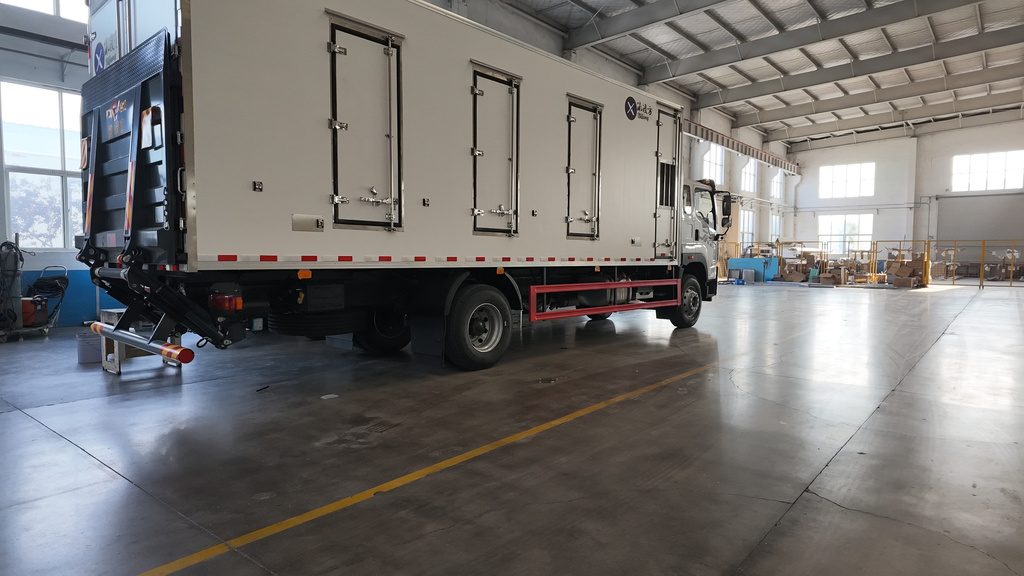
- Ventilated chick trucks carry 232 boxes at 4.2 m, 464 at 6.8 m, 536 at 7.8 m and 672 at 9.6 m — the load size, and therefore the loading time, scales with the body.
- A constant-temperature 9.6 m unit carries 624 boxes as 24 carts of 26, which changes loading from manual carry to cart movement.
Two Sides: A vs B
- Whose clock is fixed — Hatchery view: the pull time is set by the incubator and cannot slide to suit a driver. Fleet view: a route that departs at a different hour each day cannot be sold to other customers or staffed predictably.
- Cost of waiting — Hatchery view: holding chicks in the chick room is the cheaper delay because conditions are controlled. Fleet view: every hour of holding compresses the driving margin, and the compression lands on the longest leg.
- Cost of moving early — Hatchery view: loading before the last chicks are ready mixes ages and grades. Fleet view: leaving early with a partial load wastes a vehicle that could have carried a full one.
- Information flow — Hatchery view: book the truck against the actual pull, not the planned one. Fleet view: a pull that moves three hours without a phone call is a communication failure, not a scheduling problem.
- Who carries quality risk — Hatchery view: once the doors close, the load is the carrier's responsibility. Fleet view: the carrier controls temperature and ventilation, not chick condition at loading.
Step-by-Step: How to Reconcile the Two Clocks
- Map the window before mapping the route. Record actual first-hatch and last-hatch times over several settings, not theoretical ones. Design the route against measured spread, not the incubator catalogue.
- Agree a pull-to-load target and a hard cut-off. A target keeps normal days efficient; a cut-off stops the "just thirty more minutes" spiral that ends with a truck leaving three hours late.
- Build the route backwards from the farthest farm. The last delivery determines departure. Working forward from the hatchery produces plans that fail on the longest leg.
- Split loads when the window is wide. Two smaller vehicles on staggered departures often beat one full truck that waits, especially when farms are close together.
- Log actuals per load. Pull time, load start, doors closed, each arrival, and any temperature or CO₂ excursion. Without this record, every review becomes a memory contest.
- Review the contract against the log. If late departures trace to hatchery pull variance, the fix is in the hatchery; if to route design, the fix is in the fleet. The log tells you which.
FAQ
Q: Is it ever acceptable to load chicks before the window closes?
A: Yes, in staged pulls, provided the boxes are separated by hatch time and the earlier chicks are not held long enough to need feed. Mixing them without labelling is what causes trouble later.
Q: How much delay is too much?
A: There is no universal number; it depends on temperature, density and chick condition at pull. Measure cumulative exposure — time, temperature and CO₂ together — rather than defending a single hour limit.
Q: Should the hatchery pay for waiting time?
A: If the delay comes from hatchery pull variance, charging the carrier is hard to justify. If the carrier arrived late against a confirmed booking, the reverse applies. Contracts that do not distinguish the two create arguments that cannot be resolved.
The Bottom Line
The hatch window should set the boundary and the truck schedule should flex inside it, because biology has no slack and logistics does. That only works if the hatchery publishes a realistic window and the carrier prices flexibility honestly rather than absorbing it silently. The worst outcome is a schedule that looks stable on paper and is quietly paid for by chick quality. So here is the question worth arguing about: in your operation, who actually absorbs the cost of a late load — and does the contract say so?
Feed Mill Logistics in 2026: Are Bulk Fleets Finally Getting Smarter?
Oct 24, 2026
Are Animal Welfare Audits Measuring the Right Things in Chick Transport?
Oct 24, 2026
Related Articles
Author

Cybercoldchain
Content Writer
Recent Posts
-
GMP+ and FAMI-QS: Is Transport the Weak Link in Feed Safety?
Oct 31
-
Driver Shortages vs Delivery Windows: What Gives First?
Oct 31
-
Telematics for Bulk Feed: Is Bin-Level Data Worth the Investment?
Oct 31
-
Can Reefers Keep Up With 45°C+ Markets—or Do Specifications Need a Rethink?
Oct 31
-
The Hidden Cost of a Late Chick Delivery—Who Should Bear It?
Oct 31