
Are Animal Welfare Audits Measuring the Right Things in Chick Transport?
In short: Most chick transport audits measure inputs and endpoints — documents, setpoints, arrival mortality — and largely miss the middle of the journey, where temperature, airflow and crowding actually decide the outcome. That makes audits necessary but not sufficient. The operators who consistently deliver good chicks are usually the ones who instrument the middle, not the ones with the thickest folder.


What Is a Chick Transport Welfare Audit?
A welfare audit is a structured check of whether a journey met a defined standard. In day-old chick transport it typically combines document review (journey logs, vehicle approval, driver training, cleaning records), physical checks (temperature setpoints, ventilation openings, stocking density, vehicle condition), and outcome measures (dead on arrival, cull rates, chick distribution in the boxes).
The important thing to understand is that an audit samples. It samples vehicles, it samples times, and it samples animals. A load that passes inspection at loading and again at arrival can still have spent four hours in a condition nobody recorded, because the auditor was not in the cab and the data logger was measuring the wrong place.
Why This Debate Matters
Welfare requirements for live poultry transport have been tightening across most export markets, and buyers increasingly ask for evidence rather than assurances. That is healthy. The problem is that evidence is expensive to produce properly and cheap to produce formally, so auditing systems drift toward what can be checked in twenty minutes with a clipboard.
Meanwhile, the biological margin in day-old chicks is narrow. They are not yet able to thermoregulate, they dehydrate quickly, and they are packed at densities that make airflow a design parameter rather than a comfort feature. A journey that looks compliant on paper — setpoint in range, ventilation open, density within the limit — can still produce a poor arrival if the air is not moving where the chicks are, or if the truck sat on a tarmac with the engine off.
The debate is not whether to audit but whether audit design measures the variables that predict outcomes or merely those that are convenient to observe. Practitioners who have opened a box after a long leg usually have an opinion.
Key Facts at a Glance
- The target cargo temperature for constant-temperature chick transport is 22–26 °C, which is a range the equipment must hold across a journey, not a single comfortable number.
- CO₂ is the practical proxy for air quality inside a loaded box; the safety threshold is ≤3000 ppm, with 2800 ppm used as a working target.
- Vehicles are specified for −35 °C to +40 °C ambient, meaning the same box has to perform in conditions that would stress a human, let alone a day-old bird.
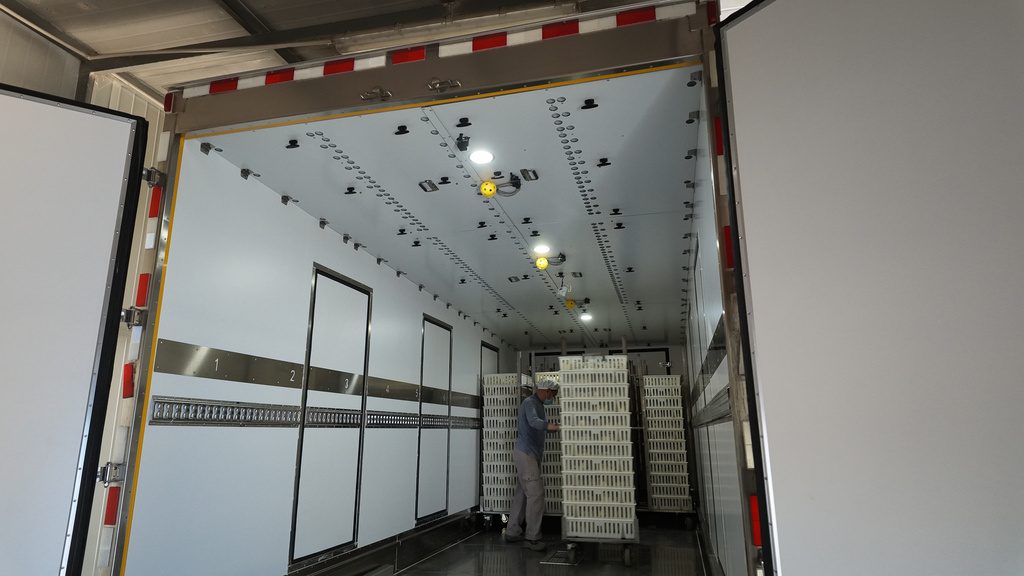
- Box density is fixed by the standard 640 × 480 × 170 mm chick box, so stocking is managed in boxes per square metre, not birds per crate.
- Capacity is body-dependent: 232 boxes at 4.2 m, 464 at 6.8 m, 536 at 7.8 m, 672 at 9.6 m for ventilated units; 624 boxes (24 carts × 26) at 9.6 m for a constant-temperature unit.
- Loading method changes the exposure profile: cart-based loading at 624 boxes is faster than hand-loading 672, which shortens the period with doors open.
Two Sides: A vs B
- What should be measured — Input view: setpoints, calibration certificates, ventilation opening positions and density limits are objective and comparable. Outcome view: arrival condition, box-level temperature spread and behaviour during the journey are what the birds experience.
- When to measure — Snapshot view: inspection at loading and unloading catches the two moments when problems are visible. Continuous view: the middle hours are unobserved, and that is precisely where excursions happen.
- Who should hold the data — Buyer view: audit evidence should be independent and verifiable. Operator view: continuous telemetry belongs to the operator, and handing over raw data invites misinterpretation without context.
- What a failed audit means — Compliance view: a finding is a defect to be corrected before the next load. Operational view: a finding without a root cause is a paperwork event that will recur.
- Cost and coverage — Depth view: fewer, deeper audits with data review. Breadth view: more frequent, lighter checks across more vehicles.
Step-by-Step: How to Audit the Middle of the Journey
- Log at box level, not cab level. A sensor near the driver measures the cab. Place logging where the air reaches the chicks, and record the spread between front and rear of the load.
- Record door-open time as an event. Loading and unloading are the largest single disturbances in most journeys; treat them as measured events with duration, not as background.
- Pair temperature with CO₂. Temperature alone cannot distinguish a well-ventilated warm load from a stagnant one. The two curves together tell you whether the fans were working.
- Sample arrival condition by position. Open boxes from the front, middle and rear, and from top and bottom of the stack. Averages hide the pattern that matters.
- Feed findings back into route design. An audit that ends in a file has failed. An audit that changes departure time, loading sequence or fan settings has done its job.
- Audit the auditor occasionally. Compare two auditors on the same vehicle. If their findings diverge, the standard is ambiguous and the scores are not comparable.
FAQ
Q: Is mortality at arrival a good welfare indicator?
A: It is lagging and insensitive: by the time mortality rises, conditions have usually been poor for hours. Useful as a backstop, misleading as a primary metric.
Q: Do data loggers replace an auditor?
A: No, but they change what the auditor should do. If sensors already record temperature and CO₂ continuously, the auditor's time is better spent on airflow, loading practice and box condition than on reading a thermometer.
Q: How many sensors are enough?
A: Enough to show the spread across the load, not just the average. A single sensor proves the equipment was on; several prove the chicks were in the condition claimed.
The Bottom Line
Audits are worth keeping, but should be judged by whether they change behaviour, not by whether they produce a clean report. The variables that predict chick quality — airflow at box level, door-open exposure, temperature spread and CO₂ accumulation — are measurable today and mostly unmeasured. Closing that gap costs less than most operators assume and buys more than most audits deliver. Which raises the uncomfortable question: if your last ten loads were audited, could you say what the temperature was at the back of the truck, three hours in?
Hatchery Windows vs Truck Schedules: Who Should Adapt to Whom?
Oct 24, 2026
Aquaculture Feed: Why Is Bulk Transport Still So Difficult?
Oct 24, 2026
Related Articles
Author

Cybercoldchain
Content Writer
Recent Posts
-
GMP+ and FAMI-QS: Is Transport the Weak Link in Feed Safety?
Oct 31
-
Driver Shortages vs Delivery Windows: What Gives First?
Oct 31
-
Telematics for Bulk Feed: Is Bin-Level Data Worth the Investment?
Oct 31
-
Can Reefers Keep Up With 45°C+ Markets—or Do Specifications Need a Rethink?
Oct 31
-
The Hidden Cost of a Late Chick Delivery—Who Should Bear It?
Oct 31