
Why Refrigerated Truck Body Weight Matters for Payload and Fuel Use
Why Refrigerated Truck Body Weight Matters for Payload and Fuel Use
In short: The weight of a refrigerated body comes straight off your payload, and payload is what you sell. A lighter body built to the same temperature standard carries more goods per trip, burns less fuel moving its own structure around, and gives you more margin against axle and gross weight limits. Weight is a design result, not a marketing adjective.


What Is Refrigerated Body Weight?
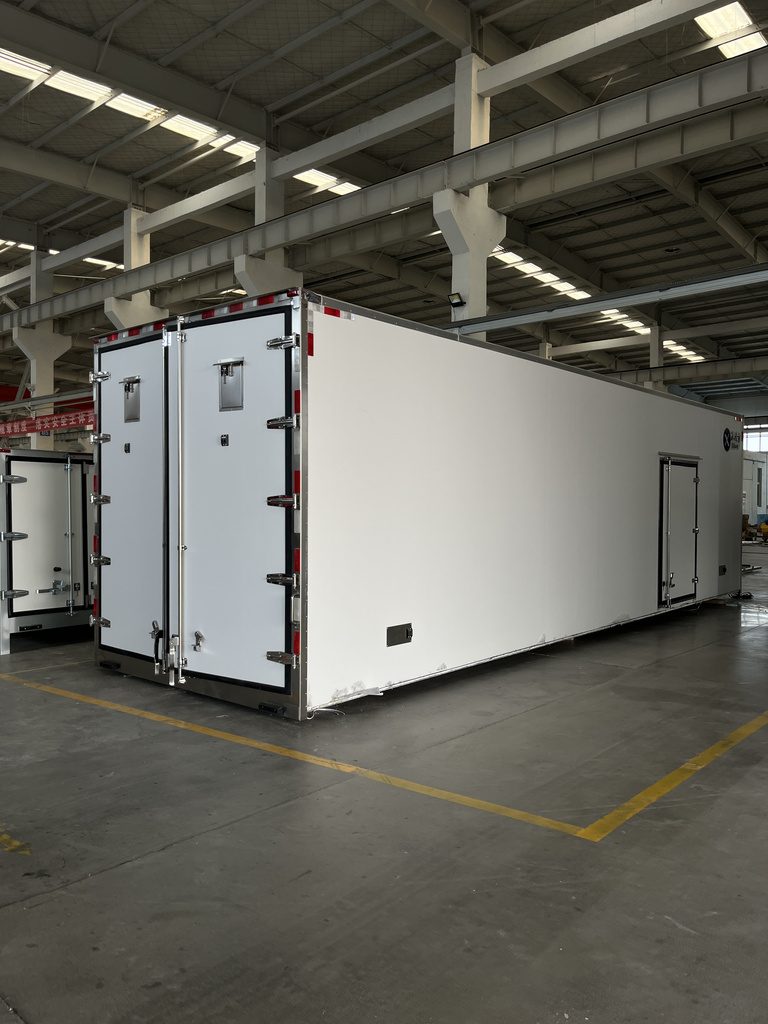
Refrigerated body weight is the mass of the insulated cargo box itself — panels, insulation core, frame, floor, doors, hardware and fitted equipment — measured before any cargo is loaded. It is added to the chassis weight to give an unladen vehicle weight, and the difference between that figure and the legal gross vehicle weight is your usable payload.
The number matters because refrigerated boxes are heavier than dry freight boxes for the same external dimensions. Insulation adds material, doors and frames add mass, and the cooling unit adds equipment. On a light chassis, this difference can be a meaningful share of the available payload, which is why buyers increasingly ask for a body weight figure in kilograms rather than an assurance that the body is light.
Key Facts at a Glance
- A 4.2 m refrigerated body can be built at roughly 670 kg, a figure that leaves a substantial share of the chassis payload rating for cargo.
- Panel thickness drives weight. Thicker insulation reduces heat gain but adds mass, so the specification should be sized to the temperature band rather than maximised.
- Core density matters as much as thickness. Polyurethane integral foam is commonly quoted with a closed-cell rate of 95 percent or higher and a thermal conductivity of about 0.022 W/(m·K), as manufacturer product parameters.
- Construction method affects mass. FRP sandwich panels are produced by dry bonding pre-cut insulation boards, while integral foam is injected between skins; both are mature lines with light build options.
- Frame and floor design is a real lever. Bodies built with kiln-dried solid timber frame sections and considered floor construction avoid unnecessary mass without sacrificing rigidity.
- Fitted equipment adds up: a larger cooling unit, partitions, extra doors and heavier hardware all reduce payload on the same chassis.
A vs B: Heavy Specification vs Light Specification
- Insulation strategy — A heavy specification uses maximum panel thickness everywhere; a light specification matches thickness to the temperature band, using thicker panels only where the heat load justifies them.
- Frame material — Heavier builds use substantial framing throughout; lighter builds use kiln-dried solid timber sections and remove material where loads do not require it.
- Door hardware — Heavier builds accept larger doors and more openings; lighter builds favour fewer, well-sized openings with simpler hardware.
- Equipment load — Heavier specification may carry more cooling capacity and accessories; light specification sizes the unit to the duty cycle rather than to worst-case assumptions.
- Running effect — Extra body mass costs fuel on every kilometre; a lighter body reduces the energy needed to move the vehicle and leaves more payload for revenue cargo.
Step-by-Step: How to Compare Body Weight in a Quotation
1) Ask for the body weight in kilograms. A quotation that describes the body as light without a number cannot be compared with another quotation.
2) Confirm what the figure includes. Panels, frame, floor, doors, hardware, cooling unit and any partitions should all be named, because exclusions make numbers look better than they are.
3) Subtract from the chassis payload rating. Use the rated gross vehicle weight and the chassis kerb weight to find the payload the body leaves you.
4) Weigh the temperature requirement against the thickness. Match panel thickness to the band you actually carry, not to the coldest product you might theoretically carry one day.
5) Review equipment for mass. Each additional door, partition and oversized unit is weight you pay for on every trip, so question whether it earns its place.
6) Verify on a weighbridge after delivery. An actual weighing confirms the unladen figure and gives you a reliable basis for loading plans and compliance.
FAQ
Q: How much payload does a refrigerated body cost me?
A: The full body weight comes off the chassis payload rating. On a light chassis, a heavily specified body can take a significant share of that rating, so ask for the body weight and do the subtraction before you commit to a chassis.
Q: Is a lighter refrigerated body less durable?
A: Not necessarily. Weight is a design result, and a well-engineered body removes material where it is not carrying load rather than thinning panels at random. The specification should be confirmed against the duty rather than assumed from the weight.
Q: Does body weight really affect fuel use?
A: Yes. Moving less mass requires less energy for acceleration and climbing, and the effect compounds over a working life. It is one of the reasons operators pay attention to body weight on multi-drop routes with frequent stops.
Q: What is the lightest configuration available?
A: It depends on temperature band, box size and door layout. A smaller box, matched panel thickness, fewer openings and a right-sized cooling unit will generally be lighter than a large box specified for the coldest duty. Ask for the figure rather than the claim.
Q: Why do you mention kiln-dried timber frames?
A: Frame material and moisture content affect both mass and stability. Kiln-dried solid timber sections used without splicing give a predictable, stable frame, which helps the body keep its shape and its seals over time.
Conclusion
Body weight is one of the few specifications you can argue about with a number on the table. Ask for kilograms, confirm what is included, subtract from the payload rating, and match panel thickness to the temperature band you actually run. Light bodies are not a marketing story; they are the result of matched insulation, considered framing and right-sized equipment. If you are comparing quotations now, make body weight one of the first questions you ask.
Bulk Feed Truck Driver Training: A Practical Checklist
Sep 21, 2026
Single Truck or Fleet? Logistics Planning for Growing Hatcheries
Sep 21, 2026
Related Articles
Author

Cybercoldchain
Content Writer
Recent Posts
-
GMP+ and FAMI-QS: Is Transport the Weak Link in Feed Safety?
Oct 31
-
Driver Shortages vs Delivery Windows: What Gives First?
Oct 31
-
Telematics for Bulk Feed: Is Bin-Level Data Worth the Investment?
Oct 31
-
Can Reefers Keep Up With 45°C+ Markets—or Do Specifications Need a Rethink?
Oct 31
-
The Hidden Cost of a Late Chick Delivery—Who Should Bear It?
Oct 31