
Meat Hook Refrigerated Truck Bodies: Design, Airflow and Loading
Meat Hook Refrigerated Truck Bodies: Design, Airflow and Loading
In short: A meat hook refrigerated body is built around overhead rails rather than shelves. The rail layout, the way cold air falls around the hanging carcasses, and the loading sequence decide whether the body performs well. Get those three right and the box holds temperature evenly from the first carcass to the last.
What Is a Meat Hook Refrigerated Truck Body?
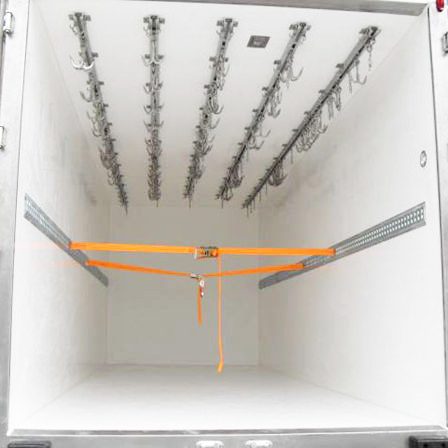
A meat hook refrigerated truck body is an insulated cargo box fitted with overhead rails or tracks that carry hanging carcasses instead of stacked pallets or boxes. The product hangs from hooks, so it never touches the floor, and air is free to move around each piece. This is the traditional format for moving whole or half carcasses from a slaughterhouse or cutting plant to markets, butcheries and distribution points.
Because the load hangs, the body design changes in several ways compared with a standard refrigerated box: the roof structure has to carry the rail and the load, the floor becomes a working and wash-down surface rather than a load surface, and the cooling strategy centres on downward airflow instead of ducted horizontal air.


Key Facts at a Glance
- Chilled carcass transport is normally run at 0 to 4 degrees Celsius, with lower set points used when the load is frozen rather than chilled.
- The payload hangs from overhead rails fixed to the roof structure, which keeps product off the floor and leaves the floor free for drainage and cleaning.
- Insulated bodies for this duty use the same two mature production methods as the rest of the refrigerated range: FRP sandwich panels made by dry bonding, and polyurethane integral foam injected between skins.
- Body weight directly reduces saleable payload. A 4.2 m refrigerated body can be built at roughly 670 kg, which leaves more of the chassis payload rating for meat.
- A defined floor drainage channel carries wash water and drip away from the working surface.
- Meat hook, pharmaceutical and live seafood variants are built alongside standard refrigerated boxes, on light, medium, heavy and semi-trailer platforms.
A vs B: Overhead Rail vs Floor-Loaded Cargo
- Loading method — Overhead rail: carcasses are hooked and pushed along tracks by hand or trolley. Floor-loaded: boxed or palletised meat is stacked on a flat floor.
- Airflow behaviour — Rail loading leaves open space around each carcass so cold air falls continuously over the surface. Floor loading blocks air paths unless spacers, channels or stacking patterns are used.
- Hygiene routine — Rail loading keeps product clear of the floor and simplifies wash-down. Floor loading protects product on pallets but requires a clean, dry floor and regular pallet inspection.
- Temperature response — Hanging product chills faster because more of its surface is exposed to moving air. Stacked product chills more slowly, from the outside in, and needs more time to reach set point.
- Typical fit — Rails suit carcass movement from processing to market. Pallets suit distribution centres, portioned cuts and mixed loads where different products travel together.
Step-by-Step: How to Load a Meat Hook Body
1) Pre-cool the body before loading. Let the box reach its set point with the doors closed so the cooling unit is not fighting a warm interior and warm product at the same time.
2) Inspect rails, hooks and the roof structure. A quick check of rail fixings and hook condition avoids a load shifting in transit.
3) Load by pushing carcasses forward along the rail, starting from the front of the body, so each new piece is added behind the previous one.
4) Keep a working gap between carcasses. Carcasses pressed against each other block airflow and create warm pockets that take much longer to chill.
5) Close the doors and confirm the seal. Check gaskets and latches before moving off; an open gasket path will defeat a correctly sized cooling unit.
6) Record the temperature at loading and again on arrival. A simple written or logged record supports food safety documentation and helps you spot patterns over time.
FAQ
Q: What temperature should a meat hook body run at?
A: Chilled carcass transport is normally run at 0 to 4 degrees Celsius. If the product is deep-frozen before dispatch, a lower set point is used. Confirm the target with the receiver, because meat quality depends on keeping the chain unbroken rather than on a single fixed number.
Q: Why do meat hook bodies use rails instead of shelves?
A: Hanging keeps each carcass separated so cold air can move around it, and it keeps product off the floor, which simplifies cleaning. It also matches how slaughterhouses and cutting plants already handle carcasses, so loading is quicker and needs less re-handling.
Q: Does the rail system affect body weight?
A: Yes. Rails, hooks and their roof fixings add weight, and that weight comes out of your payload. Ask for a total body weight figure in kilograms so you can compare it against the chassis payload rating honestly.
Q: Can one body carry both hanging carcasses and boxed product?
A: Some operators specify removable or partial rail systems so the box can also take pallets. The trade-off is complexity and weight, and airflow planning becomes more important because stacked product blocks falling air.
Q: How often should the interior be cleaned?
A: After every load that has contacted exposed product, and more often in warm weather. Wash-down with a defined drainage channel is fast, and following a written routine keeps the box in a condition that passes food transport inspections.
Conclusion
Meat hook refrigerated bodies work when three things line up: rails that carry the load safely, airflow that reaches every hanging carcass, and a loading discipline that leaves space between pieces. The insulating technology underneath is the same mature sandwich and integral foam construction used across the refrigerated range, so the practical difference usually comes from layout and routine. If you are specifying a hanging meat body, start with the rail layout and the temperature target, then confirm the total body weight before you commit.
Constant Temperature Chick Transport Truck – 22–26°C for Safe Poultry Delivery
Jul 25, 2026
Chick Transport Truck Total Cost of Ownership: What to Budget
Sep 10, 2026
Related Articles

Author

Cybercoldchain
Content Writer
Recent Posts
-
Hydration and Ventilation Balance in Day-Old Chick Transport
Sep 14
-
Can Refrigerated Body Panels Be Repaired? FRP Sandwich and Polyurethane Compared
Sep 14
-
Bulk Feed Truck Inspection and Preventive Maintenance Schedule
Sep 12
-
Day-Old Chick Delivery: A One-Page Driver Checklist
Sep 12
-
Biosecurity for Chick Transport Trucks: Cleaning and Disinfection Between Runs
Sep 12