
Leasing vs Buying a Reefer Body: Which Actually Wins Over Five Years?
In short: Over a five-year horizon, buying usually wins on total cost if the vehicle stays busy and you intend to keep it. Leasing wins when utilisation is uncertain, when maintenance risk is hard to price, or when the balance sheet is the binding constraint. The deciding variable is not the financing rate — it is how many loaded pallets the body actually carries before the contract ends.


What Is Reefer Body Leasing?
Reefer body leasing is a contractual arrangement in which a carrier pays for the use of a refrigerated body — and sometimes the chassis, the unit and the maintenance — without owning the asset. The common structures differ mainly in where risk sits:
- Finance lease — payments amortise most of the asset's value and the carrier usually ends up owning it. Economically close to a loan with a residual.
- Operating lease or contract hire — the lessor keeps the residual risk and often the maintenance. Higher monthly cost, cleaner exit.
- Body-only arrangements — the carrier supplies the chassis and leases the body and unit, common where chassis supply is financed separately.
The distinction that matters is risk allocation. Whoever holds the residual value also holds the risk of an asset that may be hard to sell.
Why This Debate Matters
Refrigerated bodies are specialised in a way dry freight bodies are not. The buyer pool is narrow, condition matters enormously, and a body specified for one commodity or climate may be worth much less to the next operator. That makes residual value harder to predict than finance models suggest.
Meanwhile capital is expensive and fleets are being asked to renew more often. A carrier that ties up cash in an under-utilised body has bought a liability with a cooling unit attached. A carrier that leases everything may be paying for flexibility it never uses. Both mistakes are common, and both are invisible in a monthly payment comparison.
Key Facts at a Glance
- A refrigerated body is a specialised asset with a narrow second-hand market; resale depends on condition, unit hours and local demand rather than age alone.
- Body life and chassis life are not the same: a body in good condition can outlast the chassis it was built on, which changes the economics of ownership.
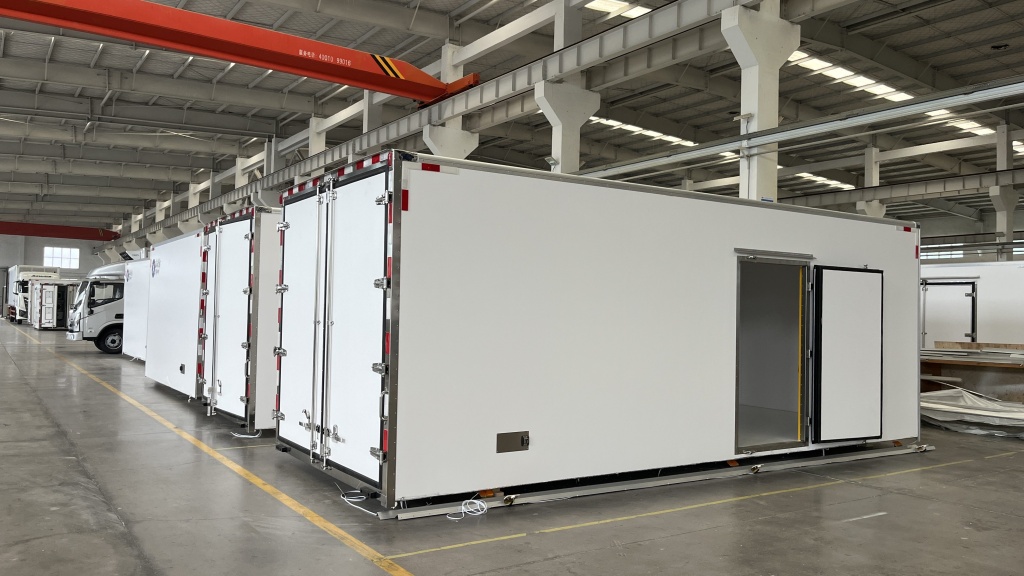
- A 4.2 m refrigerated body can weigh around 670 kg, and every kilogram of body is payload that cannot earn — so a heavier specification has a revenue cost as well as a purchase cost.
- Utilisation drives fixed cost per pallet: the same monthly payment spread over more delivered pallets falls, and no financing structure changes that arithmetic.
- Insulation performance degrades through damage and moisture ingress, shifting repair and performance risk to whoever owns the body at that point.
- Contract return conditions matter: mileage limits, body condition standards and damage charges can convert a cheap lease into an expensive exit.
Two Sides: Buy vs Lease
- Cash flow — Buy camp: a purchase is a one-off outflow and the asset stays on the balance sheet as collateral; Lease camp: predictable monthly cost preserves working capital for operations and absorbs seasonal swings.
- Total cost over five years — Buy side: once paid for, the body keeps earning with no further financing charge; Lease side: payments continue for the whole term and usually exceed purchase cost plus a realistic residual.
- Residual risk — Buy side: the owner captures any residual value but absorbs a weak market; Lease side: the lessor carries that risk, which is worth paying for when resale is uncertain.
- Maintenance — Buy side: the owner controls repairs and can use specialists, cheaper where the fleet has workshop capability; Lease side: contract hire bundles maintenance and turns unpredictable repairs into a fixed line.
- Flexibility — Buy side: the asset can be sold, re-mounted or kept past its planned life; Lease side: exit at term end is clean, which matters when contracts are short.
- Specification freedom — Buy side: unusual dimensions, doors or lining can be specified freely; Lease side: standardised specifications are cheaper because they re-market easily.
Step-by-Step: How to Decide
- Calculate honest utilisation. Use loaded pallets or loaded kilometres, not available days. A body idle two days a week is a different proposition from one running double shifts.
- Separate body life from chassis life. If the body will realistically outlive two chassis, ownership math improves because the asset is amortised over a longer revenue stream.
- Price maintenance risk using your own history. Pull three years of repair invoices for similar bodies. If variance is wide, that uncertainty has real value and transferring it may justify the premium.
- Read the exit before the entry. Return condition standards, damage schedules and early termination terms decide whether the flexibility you pay for exists.
- Model the residual conservatively. Assume a narrower buyer pool than the lessor's model, and test whether the deal works if the body sells for materially less.
- Compare cost per delivered pallet, not monthly payment. Put both on the same utilisation curve and route profile. The structure that wins at low utilisation often loses at high utilisation.
FAQ
Q: Is leasing always more expensive than buying?
A: Usually over a full term, because the lessor carries risk and cost of capital. The exception is low or uncertain utilisation, where the flexibility avoids a worse outcome.
Q: Can a leased body be modified for a specific cargo?
A: Sometimes, with the lessor's consent, but modifications often create return-condition liabilities. Ask before signing rather than after fitting.
Q: What happens if the body is damaged mid-term?
A: It depends on the contract and insurance. Most leases require restoration to a defined standard, so repair quality — not just cost — becomes the carrier's problem.
Q: Does a heavier body hurt the lease comparison?
A: It hurts either way, because payload capacity is revenue capacity. Weight is a specification decision that sits above the financing question.
Q: How long should the comparison horizon be?
A: Long enough to cover a full body life rather than a single chassis cycle. A five-year window is common, but a body that outlives two chassis deserves a longer view.
The Bottom Line
Buying and leasing solve different problems. Buying turns capital into a long-lived revenue asset and hands you residual risk; leasing turns residual risk into predictable cost and gives you less flexibility. Neither is intrinsically cheaper — a lease answers a cash flow question, a purchase answers a utilisation question.
Which one are you actually solving for: the balance sheet, or the pallets?
Seafood Haul: Is Corrosion the Real Reason Fleets Replace Bodies Early?
Oct 28, 2026
Feed Truck Economics: Is Depreciation the Number Fleets Ignore?
Oct 28, 2026
Related Articles
Author

Cybercoldchain
Content Writer
Recent Posts
-
GMP+ and FAMI-QS: Is Transport the Weak Link in Feed Safety?
Oct 31
-
Driver Shortages vs Delivery Windows: What Gives First?
Oct 31
-
Telematics for Bulk Feed: Is Bin-Level Data Worth the Investment?
Oct 31
-
Can Reefers Keep Up With 45°C+ Markets—or Do Specifications Need a Rethink?
Oct 31
-
The Hidden Cost of a Late Chick Delivery—Who Should Bear It?
Oct 31