
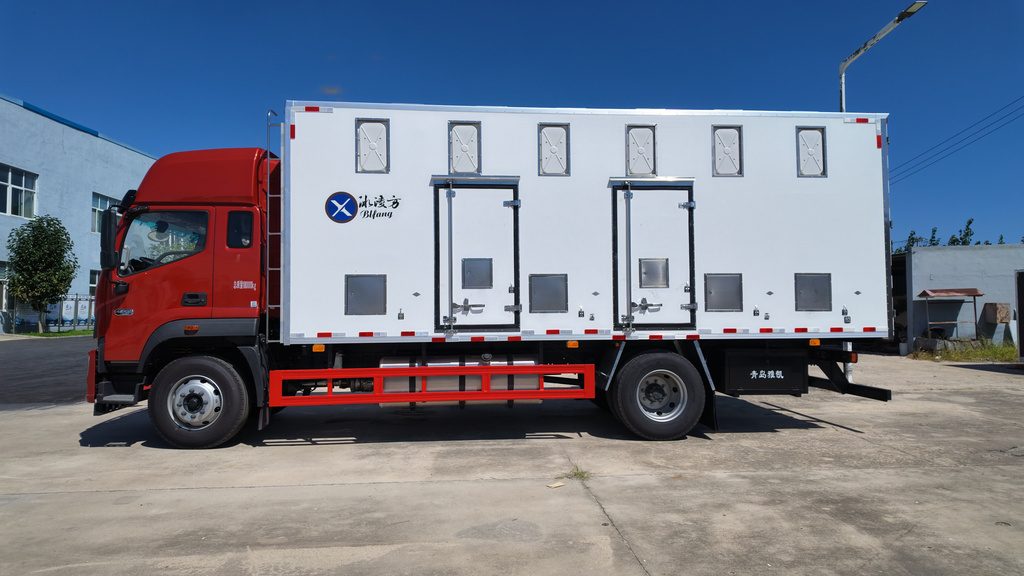
CO₂, Humidity or Airflow: Which Ventilation Metric Matters on Chick Trucks?
In short: No — CO₂ is the strongest single alarm but a poor sole diagnosis. It tells you the air is accumulating metabolic waste, while temperature, humidity and air speed tell you why. A truck can hold 22–26 °C and still fail a load, and it can show an acceptable CO₂ curve while doing so.


What Is Ventilation in a Chick Truck?
Ventilation is the managed exchange of air between the cargo space and the outside, plus the internal movement that distributes it. In a chick truck it has three jobs at once: remove CO₂ and moisture produced by the birds, bring in oxygen, and carry heat away from the load so the cooling or heating system can hold its target.
Engineers describe this with airflow rate, static pressure and air changes. Operators describe it with a hand at a vent and a look at the boxes. Both are describing the same thing, which is why arguments about ventilation often sound like two languages.
Why This Debate Matters
CO₂ monitoring has become inexpensive and fashionable, and that is mostly good. A sensor gives an early warning that something is wrong before chicks show it, and it creates a record that can settle an argument after arrival.
The risk is substitution. A number on a display can create the impression that ventilation has been measured when only one consequence of it has. CO₂ responds slowly and lags behind the actual event: airflow can fail for a while before the concentration climbs noticeably, especially in a partially loaded truck.
Meanwhile the variables that cause most failures are less visible. Uneven airflow leaves hot pockets at the rear; high humidity reduces the bird's ability to lose heat; low air speed at box level leaves stale air around the chicks even when the bulk average looks fine. None of these announce themselves on a single CO₂ reading.
Key Facts at a Glance
- The CO₂ safety ceiling is 3000 ppm, with 2800 ppm used as an operating target; averages across the load hide local pockets above the limit.
- Cargo temperature targets 22–26 °C, a band narrow enough that uneven airflow can push one zone out while another stays in range.
- Equipment is specified for −35 °C to +40 °C ambient, so the ventilation load varies enormously between a winter run and a summer run.
- The standard chick box is 640 × 480 × 170 mm; stacking pattern and box perforation determine whether air reaches the birds or passes over the stack.
- Load size changes the problem: 232 boxes at 4.2 m versus 672 at 9.6 m on ventilated units, and 624 boxes (24 carts × 26) on a 9.6 m constant-temperature unit.
- Ventilated units move air with fans and ventilation windows, with an optional auxiliary cooling unit of limited effect; constant-temperature units hold the band with active cooling and controlled fresh-air exchange.
Two Sides: A vs B
- What to trust — CO₂ view: it is the one metric that integrates bird load, airflow and time into a single number. Engineering view: it is an outcome, and outcomes without causes cannot be corrected.
- What to install — Sensor view: add CO₂ loggers to every vehicle and manage by threshold. System view: add temperature spread across the load and a pressure or fan-status signal, which is what actually explains the CO₂ curve.
- Where to measure — Average view: a central sensor represents the load. Distribution view: rear, top and bottom positions differ, and the worst position is the one that matters.
- How to ventilate — Fresh-air view: more exchange solves CO₂. Recirculation view: in extreme heat, dumping cooled air to chase a number wastes capacity and can chill chicks near the inlets.
- What to do at the limit — Alarm view: open vents and continue. Protocol view: change fan speed, adjust load distribution, or shorten the route — decisions a threshold alone does not suggest.
Step-by-Step: How to Read Ventilation Data
- Start with temperature spread, not the average. Compare front, middle and rear. A wide spread means the air is not being distributed, whatever the CO₂ says.
- Read CO₂ as a trend, not a snapshot. A slow climb suggests accumulating load; a step change suggests a door, a fan failure or a blocked filter.
- Check humidity alongside temperature. High humidity with normal temperature means the birds cannot lose heat by evaporation, which is a ventilation problem even when the thermometer agrees.
- Confirm air is moving where the birds are. Use a smoke pencil or a light ribbon at box level, not at the outlet. Air at the outlet proves the fan runs, not that the load is ventilated.
- Match the setting to the load, not the calendar. A partly loaded truck needs different airflow from a full one, and a 672-box load needs more than a 232-box load.
- Write the response into the driver card. If CO₂ passes a threshold, the driver should know which two actions to take before calling anyone.
FAQ
Q: Is CO₂ or temperature more important?
A: Neither alone. Temperature tells you whether the thermal target is met; CO₂ tells you whether the air is being renewed. A load can fail on either, so both belong on the same chart.
Q: Why does CO₂ lag behind a ventilation failure?
A: Because the cargo space and the boxes contain a buffer of air, and metabolic production is gradual. By the time the reading moves sharply, the condition has existed for a while.
Q: Do constant-temperature trucks need ventilation at all?
A: Yes. Cooling is not ventilation: a sealed, cold box still accumulates CO₂ and moisture. Constant-temperature units combine active cooling with controlled fresh-air exchange for that reason.
Q: What is a realistic airflow target?
A: It depends on bird mass, box pattern and outside temperature, so there is no universal figure. Measure the outcome at box level and adjust until the worst position stays inside the band.
The Bottom Line
CO₂ earns its place as the alarm, not as the whole instrument panel. The operators who get ventilation right tend to watch three things together — temperature spread, humidity and CO₂ trend — and then go and feel the air where the chicks actually are. That is engineering, and it does not require an engineering degree. So a question for the operators reading: what made you realise your airflow was uneven — a number on a screen, or a box at the back of the truck?
Multi-Species Feed: How Serious Is the Medication Segregation Risk?
Oct 28, 2026
Pharma Cold Chain Audits: Are Small Fleets Being Priced Out of Compliance?
Oct 28, 2026
Related Articles

Author

Cybercoldchain
Content Writer
Recent Posts
-
GMP+ and FAMI-QS: Is Transport the Weak Link in Feed Safety?
Oct 31
-
Driver Shortages vs Delivery Windows: What Gives First?
Oct 31
-
Telematics for Bulk Feed: Is Bin-Level Data Worth the Investment?
Oct 31
-
Can Reefers Keep Up With 45°C+ Markets—or Do Specifications Need a Rethink?
Oct 31
-
The Hidden Cost of a Late Chick Delivery—Who Should Bear It?
Oct 31