
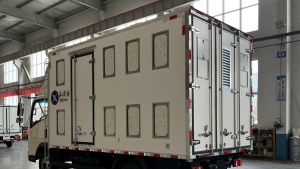
Chick Truck Body Materials Guide – FRP Sandwich vs Polyurethane Foam
The body material of your chick transport truck determines insulation performance, durability, and maintenance cost. Here's a comparison of the two main options.
**FRP Sandwich Panel (Dry-Bond Method)**
The inner and outer skins are FRP (fiberglass reinforced plastic) with pre-cut insulation board in between, bonded with adhesive and pressed together using a hydraulic press.
- Mature process, well-suited for small-batch custom builds
- High structural strength, easy to repair (individual panels can be replaced)
- Flexible for different sizes and configurations
- Slightly heavier than foamed construction
**Polyurethane In-Situ Foaming**
Liquid polyurethane is injected between the inner and outer skins, expanding and curing into a seamless insulation layer.
- Seamless construction — no glue joints means no thermal bridging
- Better, more uniform insulation performance
- Stronger, more rigid body structure
- Ideal for standardized mass production
- More complex to repair (requires cutting and re-foaming)
**Which One Should You Choose?**
If you need extensive customization (non-standard openings, special dimensions), the sandwich panel method is more flexible. If insulation performance and overall build quality are your priorities, and standard dimensions work for you, choose polyurethane foaming.
Binglingfang runs both production lines and can recommend the right approach based on your requirements.
**Why FRP?**
Some buyers question whether FRP is as durable as metal. FRP actually has an excellent strength-to-weight ratio, is corrosion-proof, and won't rust. For chick transport — where frequent washing and disinfection are standard — FRP's corrosion resistance is a real advantage. FRP also has naturally low thermal conductivity, making it a good insulator in its own right.
Why Ventilation Matters in Day-Old Chick Transport
Jun 8, 2026
How to Reduce Chick Mortality During Transport
Jun 12, 2026
Related Articles
Author

Cybercoldchain
Content Writer
Recent Posts
-
Hydration and Ventilation Balance in Day-Old Chick Transport
Sep 14
-
Can Refrigerated Body Panels Be Repaired? FRP Sandwich and Polyurethane Compared
Sep 14
-
Bulk Feed Truck Inspection and Preventive Maintenance Schedule
Sep 12
-
Day-Old Chick Delivery: A One-Page Driver Checklist
Sep 12
-
Biosecurity for Chick Transport Trucks: Cleaning and Disinfection Between Runs
Sep 12